

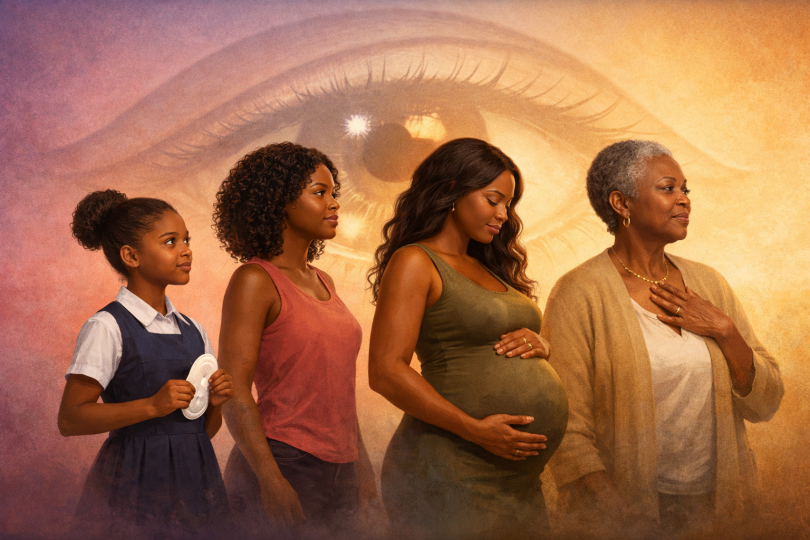

Our hormones as women influence more than our mood and reproduction. They journey with us from our menarche all through the rest of our menstrual cycle, pregnancy, and menopause. But that’s not all hormones do. They also subtly, and sometimes significantly, impact Black women’s eye health and vision.
These hormonal shifts carry greater consequences for Black women compared to their white counterparts. Earlier onset of perimenopause, higher rates of hypertension and diabetes rates, and a disproportionate risk of glaucoma all point to the fact that hormonal changes could affect our vision sooner, be more severe, and have a longer-lasting impact on women in our community.
Why Hormones Matter for Eye Health
According to the American Academy of Ophthalmology, many women experience vision changes at different points in their adult lives. The culprits? Estrogen and progesterone! When hormone levels change, it can also cause a sharp shift in the eye oil glands, often leading to dry eyes.
In particular, estrogen reduces corneal stiffness, which affects how light enters the eyes, according to the University of Utah Health. This dryness and change in refraction are the leading causes of blurred vision among many women, making it difficult for them to comfortably wear contact lenses.
The combined effect of hormones from pregnancy, menopause, menstrual cycle, and birth control pills is the primary reason most women are constantly dealing with fluctuating vision throughout their lifetime.
Menstruation and Vision Changes
The Military and Veterans’ Health reports that many women complained of contact lens discomfort during menstruation and pregnancy. This intolerance for contact lenses can be attributed to the fact that our eyes experience:
- Dryness
- Decreased visual acuity
- Swollen lids
- Tearing
- Visual coordination problem
- Eyes strain and headache
- Light sensitivity
- Foreign body sensation
While I have noticed that these issues are temporary and my vision improves around ovulation, the whole cycle repeats from the premenstrual phase to menstruation, when my vision becomes less sharp. Some women experience more episodes of blurred vision, light sensitivity, etc., and are left with only a few days to enjoy good vision. Dr. Allyson Tang, an Optometrist, opines that this condition is caused by fluid retention affecting the cornea.
According to many studies, Black women already experience more dramatic hormonal fluctuations and higher rates of inflammatory conditions. Ultimately, these fluctuations and inflammatory conditions may be just a few of the culprits affecting our eyes with greater impact.
If you are a sistah experiencing hormonal fluctuations, try these tips to feel better:
- Sleep well
- Manage stress levels
- Reduce screen time
- Use preservative-free artificial tears if you experience dryness
- Stay hydrated
However, despite these tips, ensure you visit your healthcare practitioner to discuss these symptoms as there could also be an underlying condition.
Pregnancy and Eye Health
Since pregnancy leads to a dramatic increase in estrogen, progesterone, and blood volume, it goes without saying that pregnant women would also experience eye-related issues. Among other things, they would experience:
- Increased eye pressure risks
- Contact lens discomfort
- Temporary vision prescription changes
So, if you are experiencing pregnancy-related hypertension and diabetes, these symptoms are not to be treated with laxity, as they could compound your vision risks.
NOTE: Many of these pregnancy-related vision changes disappear within a month after delivery.
If you’re going through pregnancy-related vision changes, you’ll find these tips helpful:
- Don’t rush to get new glasses; wait until after delivery
- Switch to glasses when contacts become uncomfortable
- Constantly monitor your blood and sugar levels
- If you experience severe blurring, flashes of light, or vision loss, see your doctor
Menopause and Long-Term Eye Health
If pregnancy causes a surge of hormones, menopause does the opposite–it causes a sustained decline in hormonal levels. Research shows that this decline comes 8.5 months earlier for many Black women, compared to our white counterparts, and often lasts longer. Johns Hopkins Medicine reports that lens strength decreases during menopause, leading to more persistent changes in eye health. Many women during this period would complain of:
- Chronic dry eye
- Increased risk of glaucoma, mostly among Black women
- Burning, itching, or gritty sensations
- Higher likelihood of cataracts
Let me quickly point out here that Black women are disproportionately affected by glaucoma. According to Glaucoma.Org, Black women are 5 times more likely to catch the disease when compared to their white counterparts. We develop glaucoma earlier than other races and even lose our vision at a faster rate. Hence, combined with menopause-related hormonal decline, it is easy to understand why we have more Black women going blind than other races.
Here are some tips that can help:
- Wear sunglasses to protect against UV damage
- Use lubricating drops
- Go for an eye exam every 1 to 2 years
- If you have conditions like diabetes and hypertension, manage them properly
Why This Matters for Black Women
As Black women, we face unique challenges in eye health. While women in general face diabetes-related eye diseases and hypertension, glaucoma further complicates things. We are lagging behind in early diagnosis due to a lack of care access, awareness gaps, and systemic health disparities.
This is why at Elevate Black Health, we are calling for preventive care and education. While, as Black women, we have come to accept hormonal changes, menstruation, pregnancy, and menopause as part of our design, we must not ignore their impact on our vision. Our shifting hormones and transitioning bodies should not prevent us from giving our eyesight the protection it deserves at every stage.
Let’s normalize early eye screenings, honest conversations, and intentional care, just as we do OB visits, because we deserve to see clearly through every season of life.
To learn more, visit these sites:
- Cleveland Clinic: Menarche. https://my.clevelandclinic.org/health/diseases/24139-menarche
- Waterbury Hospital: Menopause. https://www.waterburyhospital.org/link/cdce7684cfff46f0a9cf0d84e77e370c.aspx
- Elevate Black Health. Eye Health: Diabetes and Nutrition. https://www.elevateblackhealth.com/eye-health-diabetes-and-nutrition/
- American Academy of Ophthalmology: How Hormones Can Affect Eyes and Vision. https://www.aao.org/eye-health/tips-prevention/how-hormones-can-affect-eyes-vision
- University of Utah Health: Hormones and Eye Health: What Women Need to Know. https://healthcare.utah.edu/healthfeed/2024/06/hormones-and-eye-health-what-women-need-know
- Elevate Black Health: 5 Unique Symptoms of Menopause for Black Women. https://www.elevateblackhealth.com/5-unique-symptoms-of-menopause-for-black-women/
- Journal of Military and Veterans’ Health: The Menstrual Cycle and Vision: The Eye is a Gender Specific and Hormonally Sensitive Target Organ. https://jmvh.org/article/the-menstrual-cycle-and-vision-the-eye-is-a-gender-specific-and-hormonally-sensitive-target-organ/
- Dr. Allyson Tang’s Optometry Clinic: Do Hormonal Changes Impact Women’s Eye Health? https://www.drtangeyecare.com/do-hormonal-changes-impact-womens-eye-health/
- Elevate Black Health: Addressing Pregnancy Pain. https://www.elevateblackhealth.com/addressing-pregnancy-pain/
- Elevate Black Health: Diabetes Made Simple: A Quick Guide. https://www.elevateblackhealth.com/diabetes-made-simple-a-quick-guide/
- University of Michigan News: 25 years of research shows insidious effect of racism on Black women’s menopausal transition, health. https://news.umich.edu/25-years-of-research-shows-insidious-effect-of-racism-on-black-womens-menopausal-transition-health/
- Johns Hopkins Medicine: Introduction to Menopause. https://www.hopkinsmedicine.org/health/conditions-and-diseases/introduction-to-menopause
- Glaucoma Research Foundation: African Americans and Glaucoma. https://glaucoma.org/articles/african-americans-and-glaucoma?gad_source=1&gad_campaignid=1554165759&gbraid=0AAAAAD4L3o3BlSXsxbCOgij6T75jY9Boz&gclid=Cj0KCQiA7rDMBhCjARIsAGDBuEA0yLDnLoax6-SZ3ciEpBv7dEx0gcU1KQL520rL1ejnHOf6ptjTSK4aAik6EALw_wcB