

Dr. Nishan Pressley, OD, is an optometrist advancing eye health in the Black community. During her optometry training, she was the first and only Black woman in the optometry program. Years later, the lack of Black representation in eye care remains a persistent challenge.
The National Eye Institute reports that Black Americans have the highest rate of blindness and vision loss from eye disease in the US. By 2030, more than 1 million are expected to have diabetic retinopathy. The Houston Defender revealed that about 190,000 Black people are living with visual impairment in the US, while the Glaucoma Research Foundation reports that glaucoma strikes the Black community earlier than other races, and it progresses faster when compared to whites.
The statistics, and the lived reality, highlight a significant gap in prevention and care. Dr. Pressley, speaking at the Future of Personal Health, emphasized, “The biggest thing is, we don’t have enough of us in optometry.” According to Dr. Pressley, this is why our community lacks care when discussing preventable eye diseases.
Presently, in many Black communities, we do not seek eye care until vision is lost or in a terrible state. Therefore, there is a need for a community-based eye health education and screening program.
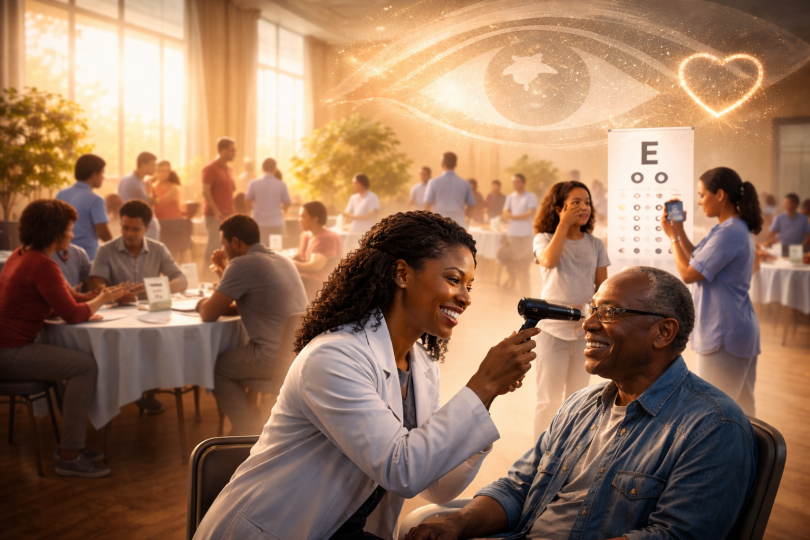
We need to close this gap by bringing awareness to where we live, worship, and learn. Churches, schools, and nonprofits are best positioned to help bridge this gap because they are trusted, accessible, and deeply rooted in the community.
Why Community-Based Eye Health Programs Matter and Steps to Take
Community-based eye health programs offer significant benefits. Among them:
- They support early detection of eye disease, helping to preserve vision
- They promote health equity by reducing disparities within Black communities
- They strengthen the economy, as good vision supports productivity and independence
The following practical steps can help guide the development and implementation of effective community-based eye health programs:
Step 1: Assess Community Needs
Before implementing a community-based eye health program, we need to understand what is unique to the Black community and what they need.
Key things to consider:
- The demography affected
- Required optometrists or ophthalmologists
- Cost
How to assess need:
- Conduct a short survey in churches and schools
- Speak with the local health workers
Step 2: Define Clear Goals and Scope
The problem will always be there, but a focused program can realistically offer a solution to specific matters. For this type of program, we can focus on:
- Eye health education workshops
- Basic vision screening
- Referrals to eye care professionals
- Follow-up support for glasses or treatment
For school, it can focus on annual vision screening for kids and parent education, while the church program targets adults for screening.
Step 3: Build Strategic Partnerships
A single person or organization cannot do this type of program. A partnership is needed for a broad reach, credibility, skills, and sustainability. Also, a community-based program offering eye exams should ALWAYS include registered eye doctors. Potential partners should include:
- Optometrists and ophthalmologists
- Teaching hospitals or eye clinics
- Nursing schools or public health departments
- NGOs focused on blindness prevention
- Optical companies or pharmacies
Step 4: Train Volunteers and Staff
The backbone of community outreach is community volunteers. They must not be eye specialists, but need to be adequately trained. Things to cover should include:
- Basic eye health knowledge
- How to conduct visual acuity screening
- Hygiene and infection control
- Data collection and confidentiality
- Referral procedures
- Patient privacy
- How to be culturally sensitive to needs on race, class, gender, and economics
Step 5: Plan Logistics and Resources
For this type of program, careful planning is essential to achieve success. The following should be planned for:
- Venue
- Screening tools
- Registration and record-keeping system
- Privacy area for the screen
- Crowd flow and time management
Step 6: Deliver Eye Health Education
Education is just as important as screening. When people recognize the importance of their health, they are more likely to get screened. For education to be effective, the following must be done:
- Keep talk short during church services or assemblies
- Interactive Q&A sessions
- Posters and flyers should have a simplified message
- Give opportunity for testimonies from individuals who benefited from early eye care
Step 7: Conduct Vision Screening
Screening is the best way to identify people in our community who need further evaluation. People being screened must know that screening is not the same as diagnosis. Some of the screening that can be done should include:
- Simple eye health observation
- Near vision check for adults
- Distance visual acuity test
Step 8: Establish Referral and Follow-Up Systems
A screening program without follow-up will have limited impact. An effective follow-up should include clear referral slips with clinic details, reminder calls or messages, and transportation support.
Putting the Right Systems in Place for Impact
In the words of Dr. Pressley, “If you have a family history of glaucoma, we need to be checking you every single year. If you have a family history of macular degeneration, you should be getting checked every single year, sometimes every six months.” A community-based eye health education and screening program can help us get our community members screened. It is practical, impactful, and achievable.
But here is the truth from Elevate Black Health: this cannot be done by one person. The Black community must leverage strategic partnerships and trust using churches, schools, and nonprofits to help prevent avoidable vision loss.
For further reading:
- Ask Dr. Nish. Dr. Nishan Pressley. https://www.askdrnish.com/
- National Eye Institute. Eye Health Among Black/African American People. https://www.nei.nih.gov/about/education-and-outreach/eye-health-among-african-americans
- Defender Network. Black community’s eye health: cataracts and risks. https://defendernetwork.com/culture/health/black-communitys-eye-health-cataracts-and-risks/
- Glaucoma Research Foundation. African Americans and Glaucoma. https://glaucoma.org/articles/african-americans-and-glaucoma
- Future of Personal Health. How One Optometrist Is Inspiring Other Future Black Doctors on Social Media. https://www.futureofpersonalhealth.com/vision-care/how-one-optometrist-is-inspiring-other-future-black-doctors-on-social-media/
- Elevate Black Health. Eye Health: Diabetes and Nutrition. https://www.elevateblackhealth.com/eye-health-diabetes-and-nutrition/