

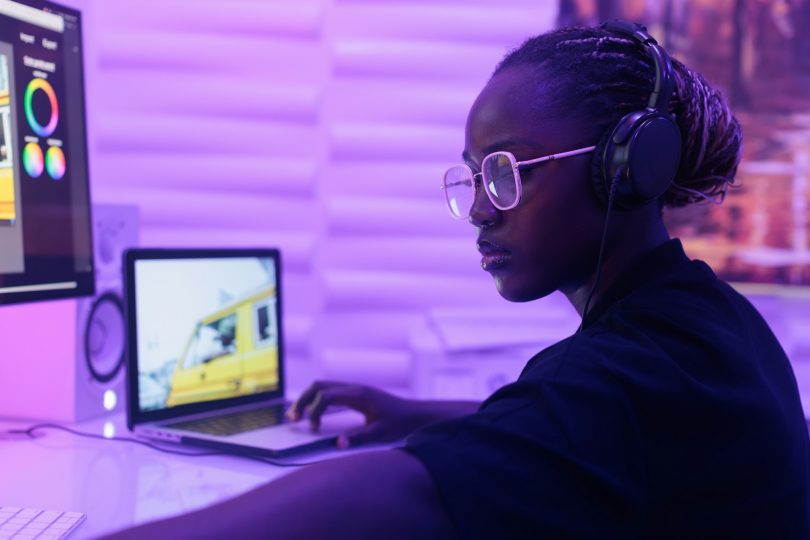

In my line of work, I spend 10 or more hours each day staring at a computer screen, working to translate complex topics into a language that is clear and useful for my readers. This level of screen time has become part of the daily life of both teens and adults in our community—whether for school, work, or entertainment. But why is that so?
Higher screen time in our community is often a product of necessity. Fewer green spaces and parks, higher traffic, greater safety concerns in Black neighborhoods, and reduced organized activities in our community often force Black families to spend more time indoors. For parents who work multiple jobs, screens have become a babysitter. However, extended screen exposure is the main cause of digital eye strain.
Symptoms of dry eyes can be initiated after just two hours of uninterrupted screen time. The risk gets worse after 5 hours. A study published in 2020 emphasized that over 8 hours of screen exposure daily was associated with symptomatic dry eyes. Beyond eye strain, the consequences of long screen time can be dire for children, including increased risk of ADHD.
Symptoms of Digital Eye Strain
Long screen time can lead to a group of eye and vision-related problems collectively called digital eye strain (DES) or Computer Vision Syndrome (CVS). This condition affects up to 90% of adults who use digital devices for long periods.
Research from Nielsen shows that Black audiences in the US spend more time on screens for entertainment compared to every other group. The reason for this was attributed to the search for culturally representative content. Sadly, the negative outcome on the eyes is usually one of the following:
- Eye Fatigue (Asthenopia): Long, intense focus causes eye muscle fatigue, leading to tired, aching, or heavy eyes. This condition is usually temporary and will resolve when the eyes are rested
- Dry Eye Syndrome: Blinking cleans and lubricates the eyes. While focused on screens, people blink 3 to 7 times a minute, which is a third less than normal. This unstable tear film leads to stinging, burning, redness, or a gritty, foreign-body sensation. As a reflex to irritation, you may experience excessive tearing
- Blurred or double vision: After long screen exposure, individuals may experience temporary blurriness due to the difficulty of the eyes to refocus from the near screen to a distant object
- Increased light sensitivity: Exposure to bright displays increases light sensitivity, and bright daylight will suddenly become uncomfortable
Although not directly related, long screen exposures can lead to tension-like headaches due to efforts to keep the eyes focused. Neck, shoulder, and back pain can also occur due to poor, static posture. Sitting long hours can also predispose you to diabetes, which can cause loss of sight.
Black Families and Longer Screen Time
Structural factors resulting from systemic racism are partly to blame for the unhealthy closeness of Black families to screens. For example, Black neighborhoods usually lack adequate safe parks and playgrounds for recreational activities. This forces them to spend more time indoors.
For families living in such neighborhoods, watching television becomes a time for family bonding. Viewing it from the bonding angle, it becomes easier to understand why they don’t count the hours spent watching television. Black children have 12% higher screen time compared to their white counterparts.
There is also the problem of unequal employment opportunities. Recent studies show that 1 in 3 Black children live in poverty, compared to less than 1 in 10 for white children. Also, Black workers earn 20% less than their white counterparts. Inequitable federal policies, including an outdated poverty threshold and a stagnant federal minimum wage, worsen the situation.
Despite infrastructural challenges, including unequal access to the Internet, more Black adults are turning to remote work for opportunities. A recent report shows that the number of Black professionals working remotely grew significantly from 0.7 million in 2019 to 2.6 million in 2021.
Remote workers are known to work odd hours, mostly driven by the need to cover different time zones. Consequently, they find themselves spending longer hours in front of a computer screen, often working in poorly-lit rooms. Working under poor lighting further increases eye strain.
Tips for Protecting Your Eyes
Although screens have become part of our daily lives, there are steps you must take to prevent the harmful effects of overexposure. For children between 2 and 5 years, it is best to limit screen time to a maximum of one hour per day. Replace screen time with outdoor activities that encourage movement and healthy eye development.
Adults should also limit screen time to below 7 hours daily. Those who use a screen for longer hours, for school or work, should follow the tips below to protect their eyes.
- Practice the 20-20-20 rule: The rule encourages you to look away from the screen every 20 minutes, at a distant object 20 feet away, for at least 20 seconds.
- Blink consciously: Blinking is significantly below normal during screen time. Blinking cautiously helps to keep the eyes moist and prevent dryness.
- Work or read in a well-lit environment: Avoid working or reading from your screen in dark rooms. Reading or working in a properly-lit room reduces glare and contrast.
- Reduce screen brightness: If the screen is too bright relative to your environment, it will increase eye strain. When using smartphones, set the screen brightness to adjust automatically relative to the environment.
- Increase text font size: Reading small print increases the strain on your eyes by forcing the muscles to remain tense.
- Schedule regular eye screening: Vision problems can be better managed if detected early.
The National Eye Institute has a campaign called “Eye Health, My Health” aimed at the Black community. The campaign promotes eye health as a crucial part of overall health. There is also the Black EyeCare Perspective, founded by optometrists to increase the representation of Black professionals. Associate with these groups, where possible, to create awareness and help improve eye health in our community.
For More Reading
- Inomata T, Iwagami M, Nakamura M, et al. Characteristics and risk factors associated with diagnosed and undiagnosed symptomatic dry eye using a smartphone application. JAMA Ophthalmol. 2020;138(1):58–68. doi: 10.1001/jamaophthalmol.2019.4815
- Nielsen. (2024, February). Creating connections with Black Americans across media. Nielsen. https://www.nielsen.com/insights/2024/creating-connections-with-black-americans-across-media/
- Emecheta, A. (2023, May). Eye health: Diabetes and nutrition. Elevate Black Health. https://www.elevateblackhealth.com/eye-health-diabetes-and-nutrition/
- Emecheta, A. (2023, June). Reclaiming outdoor space with pets. Elevate Black Health. https://www.elevateblackhealth.com/reclaiming-outdoor-space-with-pets/
- FPWA. (2024, August 28). New 2024 data highlights ongoing economic disparities faced by Black people due to systemic discrimination. FPWA. https://www.fpwa.org/resource-center/blogs/new-2024-data-highlights-ongoing-economic-disparities-faced-by-black-people-due-to-systemic-discrimination/
- Burrows, M., Burd, C., & McKenzie, B. (2023, April 6). More people in all race/ethnic groups worked from home 2019–2021. U.S. Census Bureau. https://www.census.gov/library/stories/2023/04/more-people-worked-from-home-2019-2021.html
- The Journal of Blacks in Higher Education. (n.d.). Enrollments. JBHE. https://jbhe.com/enrollments/
- Kukaswadia, A., Pickett, W., & Janssen, I. (2008). Time since immigration and ethnicity as predictors of physical activity among Canadian youth: A cross-sectional study [Table 5]. BMC Public Health, 8, Article 366. doi.org.