

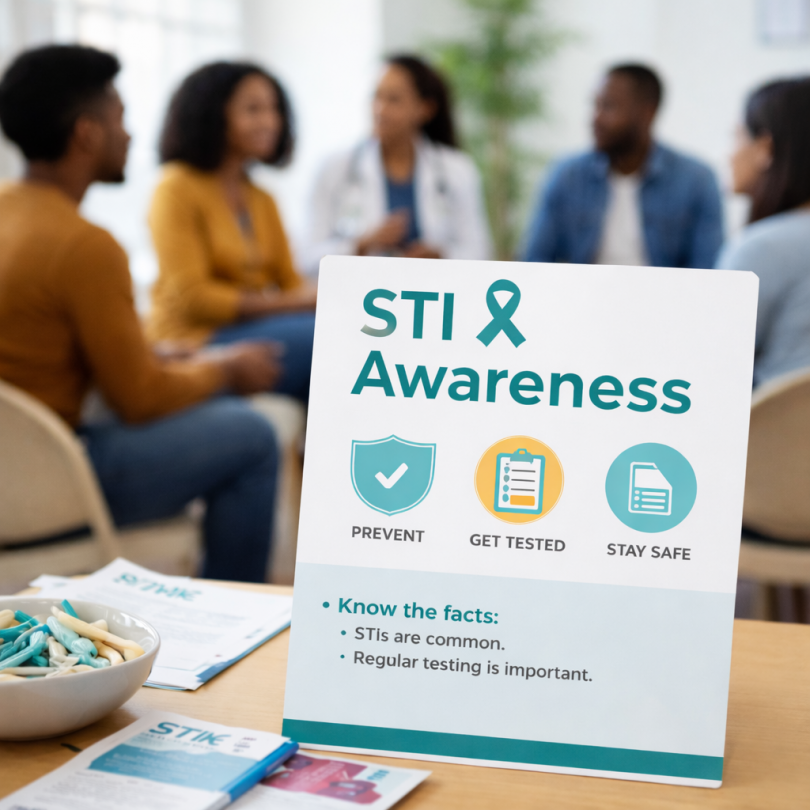

Capital B News, Nursing for Women’s Health, and the National Institute of Health have all reached the same conclusion: Black communities are disproportionately affected by STIs. Testing is a sure way to address the issue of STIs in the Black communities, but certain barriers to testing still need to be looked into.
In 2024, Dr. Rodman Turpin, an assistant professor in the Department of Global Community Health at George Mason University, made a profound observation about STIs in Black communities: “Black communities both historically and currently face discrimination and mistreatment by the medical system.” This reality remains a significant barrier to effectively addressing and reducing STIs in Black communities.
It may surprise you that in 2026, Black Americans still face the following medical barriers:
- Limited access to healthcare service
- Stigma around testing
- Higher STIs rate
- Mistrust of the healthcare system
- Medical racism
- Fear of judgment and confidence concern
- Lack of comprehensive sexual health education
- Fewer testing opportunities and clinic availability
- Socioeconomic barriers
- Cultural and community norms
- Lack of perceived risk
- Structural inequality
- Provider bias and poor patient experience
Once these issues are addressed, it becomes easier to ask: how often should I get tested for STIs? Where can I get a free or low-cost test?
Despite the obvious barriers, it is still important for these questions to be asked, because while these barriers persist, STIs are still transmitted in the Black community, with the Centers for Disease Control and Prevention reporting that Black people account for 42% of new cases of HIV and 16.3% death rate when compared to whites at 2.5%.
STIs don’t always show obvious signs. Many infected people feel just fine and go about their daily activities, but inside, the infection is gradually gaining ground, waiting for the right time to manifest. Worse, many unknowingly infect others. So, despite the mountains of barriers we are facing as Black people in the US, we must overcome all odds to see that regular testing becomes a norm in our community.
Why Regular Testing Matters
Routine STI testing helps us to:
- Detect infections early
- Protect our partner(s)
- Prevent long-term health complications
- Take control of our sexual health
So the real question now is: HOW OFTEN IS REGULAR TESTING?
- If you’re sexually active.
If you are sexually active, the general rule is to get tested at least once a year. Now, don’t say, “Oh, I have no symptoms;” an annual check-up is a good baseline.
- If you have multiple or new partners.
If you are in this category, then you are required to test at least every 3 to 6 months. Also, if you are someone who doesn’t consistently use protection during sexual intercourse, run a test every 3 to 6 months.
- By age group.
People aged 15 to 24 are considered high risk; they should be tested at least once a year if they have one partner. It is highly recommended that they screen for Gonorrhea and Chlamydia.
For those aged 25 and above, we recommend testing based on risk factors—more frequent testing for those living a risky lifestyle.
- If you are pregnant.
As soon as you discover you are pregnant, get tested. If possible, take another test later in the pregnancy. These tests are important because they help protect both mother and child from complications caused by infections like syphilis.
- When you have certain symptoms.
If you have symptoms such as unusual discharge, soreness, itching, or pain during urination, don’t waste time; it could be a warning sign. Just go for the test immediately.
For STIs like HIV, we recommend you run a full checkup every year during STI Awareness Month in April.
Where Can You Get Free or Low-Cost STI Testing?
Cost has been a major barrier, but in many places in the US, that barrier has been broken even for Black people without insurance. Here are 5 reliable places you can get tested if you are living in the US:
- Planned Parenthood Health Centers.
Planned Parenthood health centers are one of the best options for people looking for free or affordable testing because of the following reasons:
- Accessible in all 50 states
- Offer free or low-cost STIs testing
- Confidential services
- Same-day test in some centers
- Local Health Departments.
Many cities and counties’ health departments often provide free STIs testing, particularly for STIs like HIV, chlamydia, syphilis, and gonorrhea. You will need to know what services your city or county health department offers. Many are usually free or low-cost.
- Community Health Centers.
There are federally funded clinics that offer testing based on your ability to pay. Some even offer treatment and follow-up care. Ask your local healthcare provider or check online to find them.
- Free STI Clinics & Nonprofit Organizations.
Many non-profit organizations run free STI screening, particularly HIV, at zero cost. The best part is that their services are fully confidential.
- College and University Health Clinics.
This is especially for students. Testing is mostly free or sometimes included in their health fees.
How to Make Testing Part of Your Routine
Many people feel very reluctant to walk into a clinic and get tested, even if it’s free. It is even more difficult when they have no symptoms. But one of the best ways to stay safe is to make testing part of our routine. I urge you to stay on track by:
- Testing on special days like birthdays, anniversaries, or the date of a milestone you achieved
- Make it a point of duty to do an STIs test before the start of any new relationship
- Always encourage your new partner to do the test with you and follow you to subsequent ones
Knowing your status is key! Testing for STIs shouldn’t be something you fear; see it as your due diligence to stay healthy. As long as you are sexually active, make STIs testing something you owe yourself and your partner, even if you are both feeling fine. The best news is that there are multiple places you can get tested for free.
To Learn More:
- Capital B News. STI Rates Are Rising. What Should You Know? https://capitalbnews.org/sti-increase-racial-disparities/
- Nursing for Women’s Health. A Systematic Review Exploring Racial Disparities, Social Determinants of Health, and Sexually Transmitted Infections in Black Women. https://www.nwhjournal.org/article/S1751-4851(22)00040-X/fulltext
- National Library of Medicine. Ethnic disparities in prevalence and screening rates of sexually transmitted infections. https://pmc.ncbi.nlm.nih.gov/articles/PMC12505147/
- College of Public Health, George Mason University. Rodman Turpin, PhD, MS. https://publichealth.gmu.edu/profiles/rturpin
- College of Public Health, George Mason University. Reducing STIs among Black sexual minority men starts with understanding their unique challenges navigating the health care system. https://publichealth.gmu.edu/news/2024-05/reducing-stis-among-black-sexual-minority-men-starts-understanding-their-unique
- Centers for Disease Control. Health Disparities in Black or African American People. https://www.cdc.gov/health-disparities-hiv-std-tb-hepatitis/populations/black-african-american.html
- Elevate Black Health. Revisiting HIV/AIDS Prevention in Black Community. https://www.elevateblackhealth.com/revisiting-hiv-aids-prevention-in-black-community/
- Elevate Black Health. Safe Sex for Black Queens: Taking Control of Your Health. https://www.elevateblackhealth.com/safe-sex-for-black-queens-taking-control-of-your-health/
- Mayo Clinic. Gonorrhea. https://www.mayoclinic.org/diseases-conditions/gonorrhea/symptoms-causes/syc-20351774
- Cleveland Clinic. Chlamydia. https://my.clevelandclinic.org/health/diseases/4023-chlamydia
- Centers for Disease Control. Syphilis. https://www.cdc.gov/syphilis/about/index.html
- Elevate Black Health. Representation and Prevention: HIV in Black America. https://www.elevateblackhealth.com/representation-and-prevention-hiv-in-black-america/