

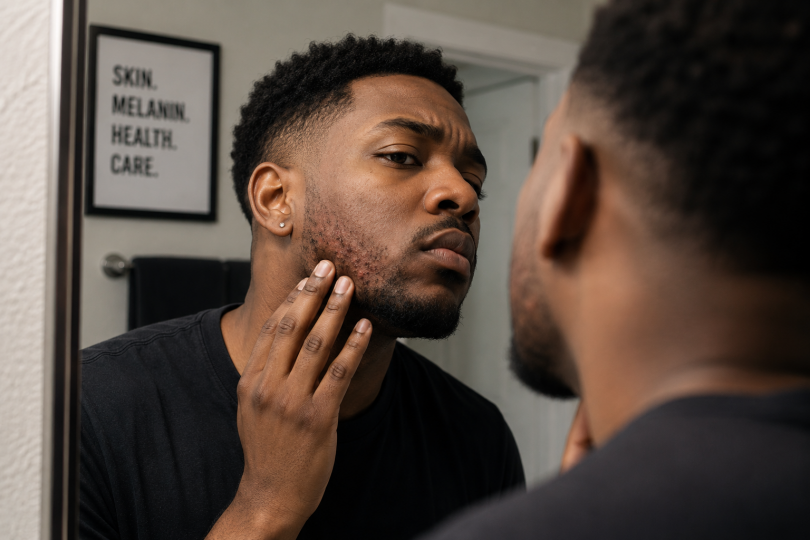

Modern dermatology has made significant improvements in non-invasive imaging, molecular diagnostics, and targeted biologic therapies. However, a gap still exists in clinical representation for melanin-rich skin. This is mostly due to historical overreliance on visual examples from Caucasian clinical archetype, specifically matching Fitzpatrick Phototypes I through III in standard medical school curricula and foundational dermatological reference textbooks. Due to this clinical bias, there is a dangerous diagnostic paradigm where the standard definition of healthy vs. pathological skin is measured against a lighter baseline.
When inflammatory skin diseases present in Black men, the visual presentation shifts dramatically. The standard cutaneous inflammation (erythema) that is characterized as a bright red or pink flush in Whites does not manifest in this manner on darker skin tones. Instead, it displays as subtle shades of purple (violaceous), deep brown, or a localized gray hue. In some cases, it may mask itself entirely behind immediate hyperpigmentation. For this reason, untrained clinicians can overlook these symptoms, leading to delayed diagnoses, therapeutic failures, or outright mismanagement.
The Objective Assessment Barrier in Black Men’s Dermatology
Erythema scales and visual scoring systems like PASI or EASI were originally designed and calibrated for low-melanin skin. Without a clear standard, clinicians often underestimate disease severity in patients of color, resulting in delayed systemic interventions. In fact, the lack of images is one reason why many conditions, including Lyme disease, spider bites, and cancers, can go misdiagnosed or underdiagnosed in darker-skinned patients, sometimes with dangerous results.
Coiled Hair Follicle Curvature
Hair architecture varies distinctly across different ancestral backgrounds. While Europeans and East Asians have straight or wavy hair shafts, Black’s hair is tightly coiled. Their shafts sprout from a curved follicular matrix embedded within the dermis. These curved follicles are highly pronounced with regular close shaving. When a sharp razor blade glides across the skin, it cleaves the hair shaft at an acute, diagonal angle. In straight hair, this sharp edge extends straight outward into the open air. In tightly coiled hair, however, the emergent hair shaft possesses a natural, physical arc that bends directly back toward the cutaneous surface. As the hair continues to grow, this sharp tip can cleanly pierce the adjacent follicular wall. It can also exit the follicle, loop completely backward, and re-enter the epidermis. When this happens, the human immune system identifies this embedded keratin shaft as an invading foreign body and initiates a localized inflammatory cascade of massive lymphocytic infiltration, microabscess formation, and subsequent tissue remodeling.
Common Misdiagnoses in Black Men’s Dermatology
1. Pseudofolliculitis Barbae (Pfb) Vs. Bacterial Folliculitis
Pseudofolliculitis Barbae or chronic razor bumps presents as clusters of highly inflamed erythematous papules along the jawline and anterior neck. These lesions fill with sterile pus that often leads to misdiagnosis of PFB as a primary bacterial folliculitis or Tinea barbae (a deep fungal dermatophyte infection). Mistaking a mechanical, structural hair issue for a primary infectious process can lead to the long-term, repeated prescription of broad-spectrum oral and topical antibiotics. While these agents provide temporary symptomatic relief, they fundamentally fail to fix the underlying structural etiology. Eventually, the natural cutaneous microbiome is disrupted, breeding localized bacterial resistance.
2. Acne Keloidalis Nuchae (Akn) Vs. Standard Acne Vulgaris
Acne Keloidalis Nuchae (AKN) begins as small, dome-shaped follicular papules on the posterior scalp and the inferior nape of the neck. In its earliest phases, it is routinely dismissed as a minor bout of backend acne. In reality, however, AKN is an aggressive follicular destructive disease process. Driven by constant friction from shirt collars or close barber fades and the natural curvature of the nape hair follicles, the hair shaft ruptures deep within the dermis. This triggers a reaction that gradually produces massive, fibrous, painful keloidal plaques. This results in scarring alopecia, chronic foul-smelling sinus tracts, and severe psychological distress. To effectively treat AKN, it demands immediate intervention with injections, topicals, or early surgical and specialized laser ablation.
3. Frontal Fibrosing Alopecia (FFA) In The Beard Vs. Alopecia Areata
Frontal Fibrosing Alopecia (FFA) is traditionally categorized as a disease primary to postmenopausal Caucasian females. However, it is common in Black men, frequently localizing within the beard, sideburns, and eyebrows. It represents a gradual, patchy, or uniform thinning of the beard area that leaves behind a smooth, shiny, hyperpigmented, or skin-colored hairless band along the jawline. Unfortunately, clinicians often misdiagnose it or misattribute the thinning to standard androgenetic alopecia. However, Alopecia Areata is non-scarring, but FFA is scarring, characterized by a lichenoid tissue reaction that permanently destroys the hair follicle stem cells. In Black men, FFA presents with a localized honeycomb pigment network and perifollicular hyperpigmentation, rather than the classic bright erythema or prominent scaling observed in lighter skin. If a clinician misdiagnoses this as Alopecia Areata and delays the administration of aggressive anti-inflammatory or immunomodulatory therapy, the window of opportunity to rescue the facial hair follicles is lost permanently.
Clinical Best Practices and Patient Self-Advocacy
Lack of representation of people of color in research and textbooks has created gaps of inequality that cause Black patients to be misdiagnosed and undertreated in the field of dermatology. To reverse this cycle of misdiagnosis and subsequent therapeutic failure, an improvement of both clinical protocols and patient advocacy frameworks is needed. The management of conditions like PFB and early-stage AKN must prioritize restructuring mechanical hair habits alongside topical medical therapies. For instance, patients suffering from recurrent PFB should adopt modern multi-blade cartridges that use the lift-and-cut mechanism. Clinicians should also advocate for the use of single-blade safety razors or specialized electric clippers. When it comes to shaving, it must be performed strictly in the direction of natural hair growth to avoid shaving against the grain. Furthermore, Black men must be equipped with the self-advocacy tools and seek board-certified dermatologists to navigate an imperfect medical system.
The systemic misdiagnosis of beard, hair, and scalp conditions in Black men represents a critical intersection of structural educational gaps, unique anatomical properties, and clinical oversights. Conditions like Pseudofolliculitis Barbae, Acne Keloidalis Nuchae, and Frontal Fibrosing Alopecia represent profound inflammatory and fibrotic processes that, when mismanaged, cause permanent physical scarring, irreversible hair loss, and long-term pigmentary and psychological trauma. Resolving this crisis demands a comprehensive overhaul of medical education by expanding the collective clinical gaze to fully encompass the structural, cultural, and biochemical realities of skin of color.
For Additional Reading
- Dermatology faces a reckoning: Lack of darker skin in textbooks and journals harms care for patients of color. https://www.statnews.com/2020/07/21/dermatology-faces-reckoning-lack-of-darker-skin-in-textbooks-journals-harms-patients-of-color/
- Inequality in dermatology brings misdiagnoses for patients of color. https://cronkitenews.azpbs.org/2020/11/24/inequality-in-dermatology-brings-misdiagnoses-for-patients-of-color/
- Krutmann, J., Piquero-Casals, J., Morgado-Carrasco, D., Granger, C., Trullàs, C., Passeron, T., & Lim, H. W. (2022). Photoprotection for people with skin of colour: needs and strategies. British Journal of Dermatology, 188(2), 168-175. https://doi.org/10.1093/bjd/ljac046
- Kuruvella, T. (2024). Tinea Barbae. StatPearls. https://www.ncbi.nlm.nih.gov/books/NBK563204/
- Melian-Olivera, A., Imbernon-Moya, A., Porriño-Bustamante, M. L., Pindado-Ortega, C., Fernandes-Melo, D., & Saceda-Corralo, D. (2025). Frontal Fibrosing Alopecia in Men: A Review of the Literature. MDPI Preprints. https://doi.org/10.20944/preprints202502.0341.v1
- Ongoro, G., Avestruz, Z., & Stover, S. (2023). Skin Inclusion: Addressing Deficits in Medical Education to Promote Diversity in Dermatological Diagnosis and Treatment. Clinical, Cosmetic and Investigational Dermatology, 16, 3481-3485. https://doi.org/10.2147/ccid.s433718
- Raffi, J., Suresh, R., & Agbai, O. (2019). Clinical recognition and management of alopecia in women of color. International Journal of Women’s Dermatology, 5(5), 314-319. https://doi.org/10.1016/j.ijwd.2019.08.005