

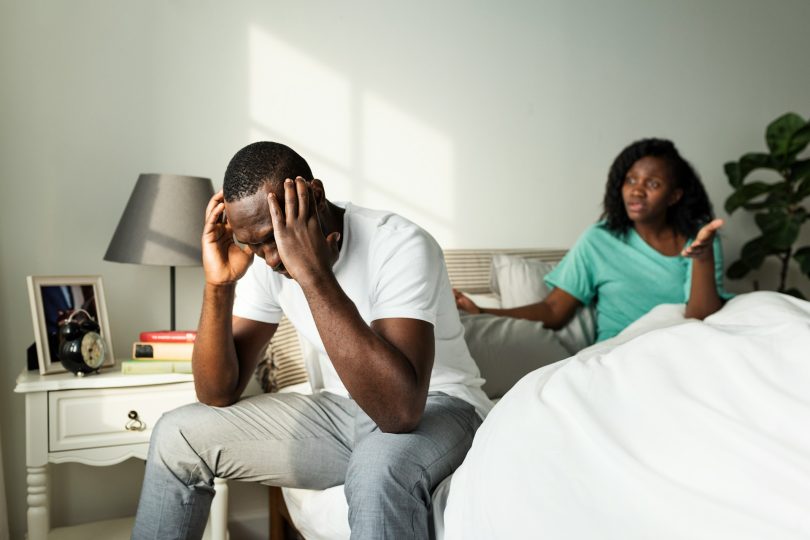

What does domestic violence look like when the person experiencing it does not fit the image of a typical victim? There may be no visible injury or police report. Instead, the signs may appear in quieter ways: a partner who checks a man’s phone, controls his money, decides who he can see or repeatedly makes him feel small. He may live with these behaviors for years without identifying them as abuse.
There is another layer to the problem: the pressure to prove that he is strong enough to handle it himself. A man who speaks about being controlled or mistreated may be asked why he did not stop it, leave or fight back. For some survivors, staying silent can feel easier than defending their experience.
Black men are not immune to intimate partner violence. CDC data from 2016/2017 found that 57.6% of non-Hispanic Black men had experienced contact sexual violence, physical violence and/or stalking by an intimate partner during their lifetime. About 12.1% reported such an experience in the previous 12 months.
These figures do not capture every form of abuse, including psychological aggression and coercive control. Domestic violence can also involve sexual violence, stalking, intimidation, humiliation, financial control and behaviors designed to restrict a partner’s freedom.
Abuse can involve control, humiliation and isolation
The word “abuse” often brings physical violence to mind. That narrow view can make psychological abuse harder to recognize.
A partner may repeatedly insult or humiliate a man, control his finances, monitor his movements, isolate him from family and friends or use threats to make him comply. Coercive control can gradually restrict someone’s choices until ordinary decisions become difficult without considering a partner’s reaction.
The absence of physical violence does not make these behaviors harmless. Repeated humiliation, monitoring and control can affect a person’s confidence, relationships and sense of safety.
Masculinity can turn asking for help into a difficult decision
Expectations around masculinity can make disclosure especially difficult. A survivor may worry that friends will laugh at him, relatives will question his strength, or others will ask why he did not simply leave.
Research specifically examining Black men’s experiences supports this concern. A 2023 exploratory study of 54 Black men who had experienced intimate partner violence found that informal help-seeking was more common than legal help-seeking. Participants described barriers that included wanting to handle the problem themselves, masculinity expectations and experiences with formal and legal systems.
The study was small and exploratory, so it cannot represent all Black men. But it shows why support cannot be designed around assumptions that Black men will automatically turn to police, courts or formal services.
Race can shape the decision to seek support
Masculinity is not the only consideration. Black men may also weigh their experiences with racism and discrimination when deciding whether to seek help.
A study of 458 black men found that more frequent everyday racial discrimination and stronger masculinity norms were associated with greater barriers to health help-seeking. The findings do not specifically measure domestic violence, but they offer useful context for understanding why approaching healthcare or other formal systems may not feel straightforward for every Black man.
For someone already questioning whether they will be believed, concerns about racial stereotypes or how their behavior may be interpreted can add another bottleneck to an already difficult decision. Support services should therefore avoid assumptions about who can be a victim and what a victim should look like.
Abuse can affect mental and physical well-being
The effects of domestic violence do not necessarily end when the incident does. Repeated threats, humiliation, isolation and control can create ongoing psychological stress.
The effects may show up in everyday life through:
- Difficulty sleeping
- Persistent anxiety or emotional distress
- Problems concentrating
- Withdrawal from friends and family
- Reduced confidence
- Difficulty functioning at work
- Ongoing fear about a partner’s reactions
These symptoms can have many causes, so they should not automatically be attributed to abuse. But when they occur alongside controlling or threatening behavior, they deserve attention.
Support starts with believing survivors and respecting their choices
Recognizing male survivors matters only when it leads to meaningful support. That starts with responses that are respectful, practical, and free of assumptions.
- Listen without blaming: Do not mock a man, question his masculinity or ask why he did not fight back
- Ask what support he wants: He may need someone to listen, professional care, legal information or help considering his options
- Create private opportunities to talk: Healthcare professionals can ask about relationship safety without a partner present
- Include male survivors: Domestic violence services should recognize that men can experience intimate partner violence
- Consider cultural context: Support should account for racism, stigma, masculinity expectations and experiences with institutions
Recognizing abuse is not a weakness
Domestic violence does not always leave a bruise, and being a man does not make someone immune to abuse. Repeated humiliation, threats, isolation and control can affect a person’s well-being and sense of freedom.
Recognizing abuse is not a failure of strength. Asking for help does not diminish a man’s dignity. Black men who experience domestic violence deserve to be believed, supported and treated as survivors without having to prove that their experiences fit someone else’s idea of abuse.
Further Reading:
- Coburn Place. A Layered Look at Domestic Violence in the Black Community. https://coburnplace.org/stories/a-layered-look-at-domestic-violence-in-the-black-community/
- Black Men’s Health. 3 Alarming Facts About Male Victims of Domestic Violence. https://www.blackmenshealth.com/3-alarming-facts-about-male-victims-of-domestic-violence/
- National Domestic Violence Hotline. Men Can Be Victims of Abuse Too. https://www.thehotline.org/resources/men-can-be-victims-of-abuse-too/
- Elevate Black Health. Black Women Coping with Violence and Trauma. https://www.elevateblackhealth.com/black-women-coping-with-violence-and-trauma/