

The World Health Organization estimates that 240,000 newborns are lost annually within 28 days of birth due to birth defects or congenital (acquired in the womb) disorders. It is usually difficult to identify a single cause of birth defects. Rather, these anomalies usually result from one or more genetic, environmental, nutritional, or infectious factors. Thankfully, congenital disorders are rare, affecting roughly 3% of pregnancies. Birth defects can manifest as:
- Brain or spine defects (eg, spina bifida)
- Eye defects (eg, anophthalmia)
- Heart defects (eg, truncus arteriosus)
- Mouth and face defects (eg, cleft lip)
- Muscle and bone defects (eg, clubfoot)
- Stomach and intestine defects (eg, tracheoesophageal fistula)
- Chromosome malformations (eg, Down syndrome)
Most birth defects are usually not easily diagnosed with ultrasounds, particularly in Black communities where gaps in healthcare access persist. Limited access to prenatal care often results in congenital disorders being diagnosed later rather than earlier.
A combination of socioeconomic and cultural factors further contributes to delays or inaccuracies in diagnosis in our community. However, the rapid expansion of artificial intelligence (AI) revolution in healthcare offers a promising opportunity to improve screening and detection of congenital anomalies for people in our communities.
Why Some Birth Defects Are More Common in Black Communities
Some congenital disorders are more common in the Black community, including polydactyly (a child born with extra fingers or toes), sickle cell, and external ear malformations. Other less common occurrences include Down syndrome, cleft lip, and neural tube defects.
Although the exact cause of congenital anomalies is almost always unknown, several factors are responsible for the disproportionate occurrence of some birth defects in the Black community. The list of contributing factors includes:
- Difficulty of parent to get care during pregnancy.
- Chronic maternal conditions like hypertension and diabetes, which have a high prevalence in the Black community.
- Exposure to environmental toxins, due to the neglected state of most Black neighborhoods.
- Chronic stress due to the more demanding jobs available to people from our communities.
- Older Black males (above 35) and females birthing children for the first time. More Black males are falling into this bracket because of increased financial difficulty and academic pursuit.
- Institutional racism, where good healthcare systems are cited far from Black neighborhoods.
Traditional Congenital Disorder Diagnostic Methods
Traditional diagnostic methods, like ultrasound, performed at 18 to 20 weeks of pregnancy, can detect congenital abnormalities like spine or heart issues. It can also spot some structural issues, like a cleft palate. However, ultrasound often fails to detect most congenital disorders that present physical symptoms until birth, and sometimes later in life. Other traditional diagnostic methods used to detect birth defects include:
- Maternal blood screening for proteins of interest: The presence of proteins (biochemical markers) like estriol (uE3), human chronic gonadotropin (hCG), and alpha-fetoprotein (AFP) in the mother’s blood can indicate an increased risk of chromosomal problems like down syndrome or neural tube disorders
- Noninvasive prenatal screening (NIPS): This is used to test the fetal DNA in the mother’s blood for markers of chromosomal disorders like Down syndrome
- Physical examination for newborns: Several defects with physical markers can be detected by the physician after birth through physical examination, especially facial and limb issues
- MRI: Special imaging after birth can provide clarity to issues that proved inconclusive with ultrasound
Certain conditions like heart defects, hearing loss, and metabolic disorders (eg, Rett syndrome) may not be easily detected until later in life, when movement, learning, and other milestones are affected.
Why Detection of Birth Defects Using AI Matters
Traditional congenital abnormality diagnostic methods depend on human interpretation, which makes them prone to false negative or false positive interpretations. Cultural differences and inherent racial bias can make it harder for white lab technicians to make accurate interpretations of results from their Black patients.
The use of AI tools in birth defect diagnoses brings precision, speed, and consistency, while also eliminating human bias and errors. AI tools particularly excel in detecting conditions with visual or structural markers, including:
- Congenital heart defects
- Neural tube defects
- Cleft lip and palate
- Limb abnormalities
- Brain development differences
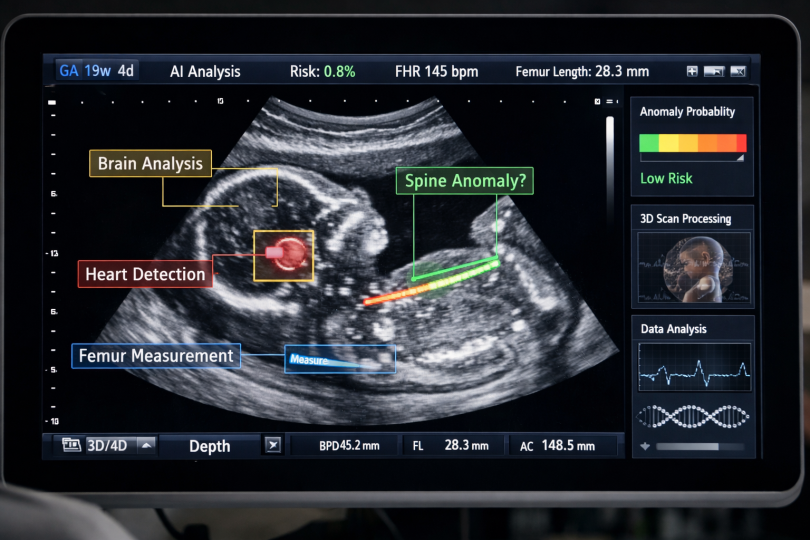
AI tools work by analyzing medical data, including blood tests, medical images, and genomic information, using machine learning to spot anomalies and patterns that human eyes may miss. These tools can analyze large datasets and spot patterns of interest faster. Below are some of the ways AI tools have revolutionized congenital disorder detection.
- Deeper and guided ultrasound analysis: Using deep learning models, physicians can analyze ultrasound images to identify anomalies. It can also identify suspicious areas and guide sonographers on the necessary images to take, eg, Sonolyst Live
- Higher accuracy in genetic and blood test analysis: AI algorithms can analyze cell-free fetal DNA (cfDNA) from the mother’s blood and more accurately predict risk for chromosomal defects, for example VeriSeq NIPT Solution v2 provided by Illumina
- Integrating and analyzing multiple data sources: Humans analyze health datasets in isolation. However, AI tools like Qlik can combine data from multiple sources, eg, ultrasound data with maternal health records, to create a more comprehensive risk assessment
Due to the advantages that AI tools present, our mothers should be proactive in asking their healthcare providers if AI tools have been integrated into their systems for congenital defect diagnosis. Adults in our communities can also petition their representatives to pass laws that will mandate the integration of useful AI tools in the screening for birth defects.
Screening fetuses without missing anomalies is important because congenital defects are associated with mortality and morbidity, especially cardiac defects. Earlier detection can improve the child’s outcome. For Black communities where ultrasound expertise is limited, the available physicians can leverage AI tools to deliver more accurate diagnoses speedily.
For More Reading
- Congenital disorders. https://www.who.int/news-room/fact-sheets/detail/birth-defects. Retrieved January 6, 2026
- Data and Statistics on Birth Defects. https://www.cdc.gov/birth-defects/data-research/facts-stats/?CDC_AAref_Val=https://www.cdc.gov/ncbddd/birthdefects/data.html. Retrieved January 6, 2026
- Environmental Factors and Birth Defects. https://www.elevateblackhealth.com/environmental-factors-and-birth-defects/
- Man’s Age and Birth Defects. https://www.elevateblackhealth.com/mans-age-and-birth-defects/
- Age 35: Fertility and Birth Defect Risks. https://www.elevateblackhealth.com/age-35-fertility-and-birth-defect-risks/
- The Future is Now. How AI can Change the Practice of Obstetric Ultrasound. https://www.youtube.com/watch?v=6kFi6RNjqnE