


HIV continues to affect Black communities in the United States and around the world more than other groups. Black people make up a larger share of new HIV diagnoses than their proportion of the overall population. This disparity reflects long-standing inequalities in healthcare access, cultural mistrust of medical systems, and social factors that influence our health. December, recognized as HIV/AIDS Awareness Month, is an important time to highlight these issues and encourage testing, prevention, and education within our Black community. Despite the availability of lifesaving prevention tools like HIV testing and pre‑exposure prophylaxis (PrEP), uptake in Black communities remains lower than optimal.
This shows why representation—through culturally informed health education, trusted community voices, and community-led efforts—is essential to reducing new infections, increasing awareness, and improving prevention readiness.
HIV Disparities in the Black Community
Although Black Americans make up roughly 13 % of the U.S. population, we account for a disproportionately high number of new HIV infections. Among women,Black cisgender women represent a majority of new HIV diagnoses compared with other racial/ethnic groups. These disparities are not due to individual behavior alone but rooted in systemic factors: historical and ongoing racism in healthcare, economic inequities, limited access to high‑quality care, and stigma around HIV.
The result of this is that our community has become burdened by preventable illness and missed opportunities for early diagnosis—especially when tools such as routine HIV testing and PrEP are underutilized.
PrEP: A Powerful but Underused Prevention Tool
PrEP is a medication taken by people who are HIV‑negative to drastically reduce the likelihood of acquiring HIV through sexual contact or injection drug use. When taken as prescribed, PrEP can reduce risk of HIV infection by up to 99 %.
Despite its effectiveness, our community uses PrEP at disproportionately low rates. National data have shown that only a small percentage of PrEP users are Black, even though Black individuals account for a large share of new HIV diagnoses. Structural barriers—including lack of awareness, limited access to culturally competent care, medical mistrust, and provider biases—contribute to these disparities.
The Importance of Representation
1. Enhances Awareness and Relevance
Health messaging that includes Black voices in leadership, advocacy, and communication resonates more deeply within the community. When people see individuals who look like them, share similar life experiences, and speak from a shared cultural context, health messaging feels more relevant and trustworthy. This is particularly critical for topics like HIV testing and PrEP, which are often stigmatized or misunderstood.
Offering programs that integrate cultural context and community representation have demonstrated improved outcomes. For example, culturally tailored interventions with Black women increased awareness of PrEP and participants’ willingness to use it.
2. Builds Trust and Reduces Mistrust
Medical mistrust is not irrational—it has historical roots in unethical research practices and everyday discrimination within health systems. This mistrust can deter individuals from seeking HIV testing, learning about PrEP, or engaging with healthcare providers about prevention strategies.
When public health initiatives are led by our community members, or when providers reflect the racial and cultural makeup of their patients, our trust increases. Black community leaders, peer educators, and culturally attuned clinicians can bridge gaps between clinical recommendations and lived experience—making PrEP and testing seem less foreign or threatening.
3. Reduces Stigma
Stigma around HIV and sexual health can limit open discussions and discourage testing or PrEP uptake. In many Black communities, conversations about sexual behavior are often silenced by cultural norms, religion, or fear of judgment.
Community representation that honestly addresses stigma—featuring narratives from Black advocates, health professionals, and everyday people—can normalize HIV prevention conversations. Awareness campaigns like National Black HIV/AIDS Awareness Day (NBHAAD) aim to empower, educate, and reduce stigma in the Black community.
4. Encourages Provider Engagement
Representation matters not only for patients but within the healthcare workforce. Culturally competent providers who understand our lived experience are more likely to talk about HIV risk and PrEP during consultations. Research shows that disparities in PrEP use often exist simply because provider–patient discussions about it are not initiated. In turn, individuals in our community are less likely to use it.
Training clinicians in culturally responsive communication and increasing diversity in health professions can help close gaps in PrEP and HIV prevention discussions. Moreover, providers from Black communities may better anticipate and address the distinct concerns of their patients—especially regarding stigma, privacy, and family dynamics.
5. Strengthens Community Ownership of Health Solutions
Community‑driven initiatives, such as mobile PrEP programs or campus leaders at Historically Black Colleges and Universities (HBCUs), have brought prevention services directly to underserved populations. These models affirm that when communities participate in designing and delivering services, uptake increases because programs are tailored to local needs and preferences.
Community ownership also generates advocacy power. Black leaders can influence policy, spearhead funding for prevention, and ensure that resources reach those most affected.
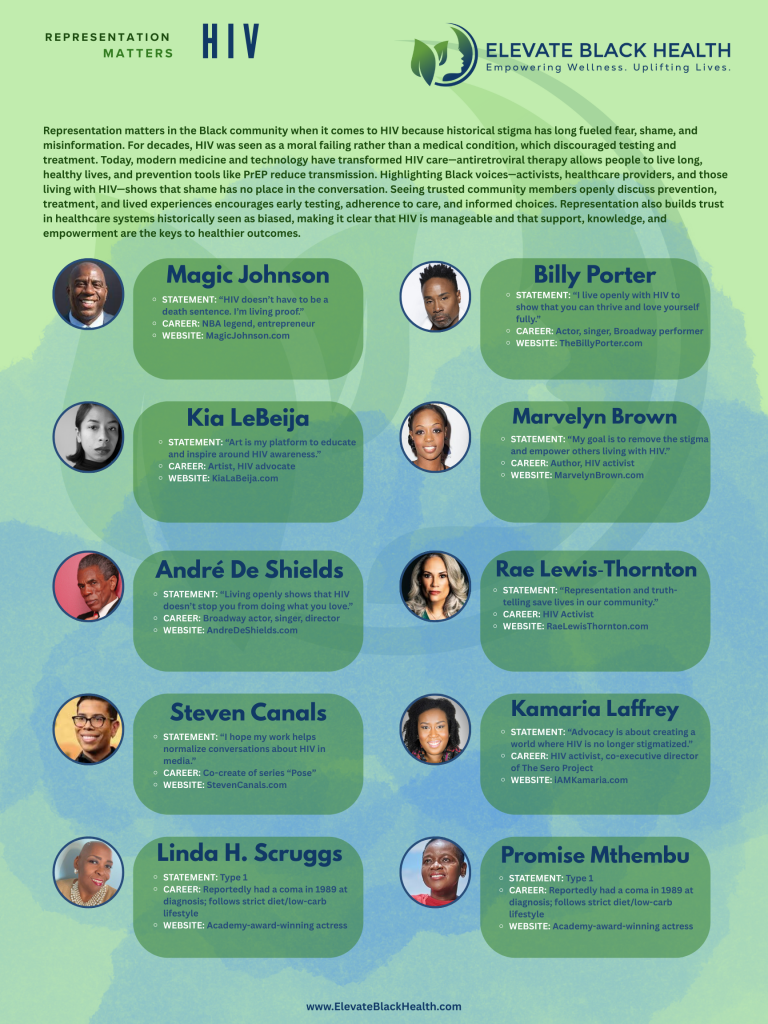
Download your copy of the “Representation Matters: HIV” poster by clicking image.
HIV Testing: A Foundational Step
Routine HIV testing remains one of the most effective ways to reduce undiagnosed infection and link individuals with prevention or care services. Unfortunately, disparities in testing persist. In some studies, Black women who inject drugs were less likely to receive HIV tests than other groups, despite similar health service use.
Representation in testing outreach—such as culturally relevant materials, peer test counselors, and trusted community venues—can elevate testing rates. It also creates environments where testing is normalized rather than stigmatized, encouraging more people to know their status.
We need to stop thinking of representation in HIV testing as a “nice to have” bonus feature in the public health sector. Representation is a “must-have” in public health, especially if we are serious about reducing disparities in HIV incidence. As we invest in Black‑led health initiatives, provider education, and community advocacy, we not only expand awareness but empowers individuals to take control of their health and help destigmatize HIV. As we continue pushing towards ending the HIV epidemic, representation must remain central to the conversation.
Want to Learn More?
- HIV.gov – Uso de medicamentos para tratar VIH y reducir la probabilidad de exposición: Profilaxis previa a exposición (PrEP)
https://www.hiv.gov/es/prevencion-del-vih/uso-de-medicamentos-para-tratar-vih-reducir-probabilidad-de-exposicion/profilaxis-previa-a-exposicion - Centers for Disease Control and Prevention (CDC) – Prevenir el VIH con la PrEP
https://www.cdc.gov/hiv/es/prevention/prevenir-el-vih-con-la-prep.html - PubMed – Culturally Tailored PrEP Interventions in Black Communities
https://pubmed.ncbi.nlm.nih.gov/39039560/ - PubMed – Structural and Social Barriers to PrEP Uptake in Black Communities
https://pubmed.ncbi.nlm.nih.gov/36622485/ - CDC – HIV Testing and PrEP Use Disparities
https://www.cdc.gov/mmwr/volumes/68/wr/mm6837a2.htm - PubMed Central (PMC) – Medical Mistrust and HIV Prevention in Black Communities
https://www.ncbi.nlm.nih.gov/pmc/articles/PMC8223201/ - PubMed – HIV Testing Among Black Women Who Inject Drugs
https://pubmed.ncbi.nlm.nih.gov/38642211/ - BMC Health Services Research – Community-Driven PrEP Programs and Uptake
https://bmchealthservres.biomedcentral.com/articles/10.1186/s12913-023-10277-1 - MDPI – HIV Risk and Prevention in Black Women
https://www.mdpi.com/1660-4601/21/11/1395 - HIVinfo.nih.gov – Día Nacional de Concientización del VIH/SIDA entre los Afroestadounidenses
https://hivinfo.nih.gov/es/understanding-hiv/hiv-aids-awareness-days/d%C3%ADa-nacional-de-concientizaci%C3%B3n-del-vih-sida-entre-los-afroestadounidenses - UNAIDS – Racial Disparities in HIV Services in the USA
https://www.unaids.org/es/resources/presscentre/featurestories/2021/november/20211115_race-hiv-service-usa