

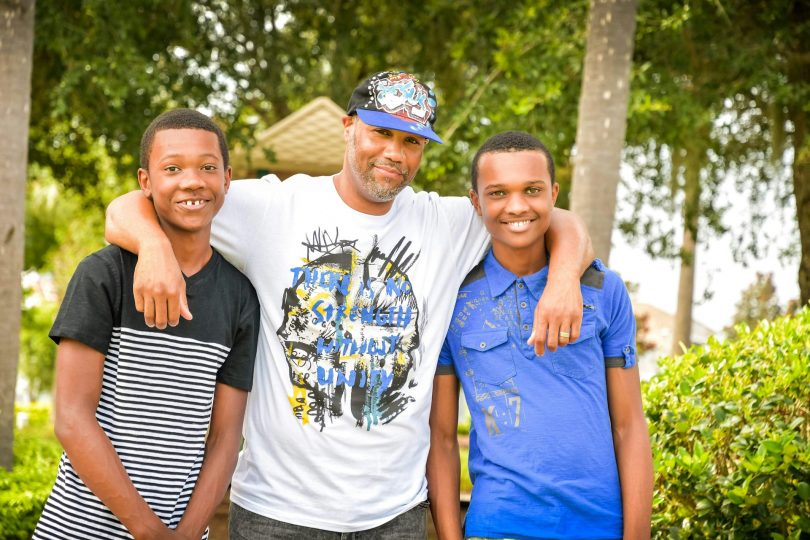

Looking back today on the conversations I had about sex, I discovered that most of the things I knew about it came from my friends, movies, and music. Several years later, with the advent of social media and the internet, I learned a few things about relationships and masculinity. Other than that, I didn’t have any meaningful conversations about sex with any adult, and it affected me because I navigated important decisions without accurate information.
Research published by Syracuse University, found that increased communication between fathers and their sons has been found to have a good impact on the reduction of risky sexual behavior. Yet many young boys still turn to the internet as a primary source of information, according to NBC News. This underscores the importance of open, honest conversations about sexual health at home.
While growing up in the Black community, sex is not something you talk about openly; even when we discussed sex as boys, it was usually in our secret meeting points. I’ve always thought that an open conversation about sex encourages sex, but far from it. It is about providing accurate knowledge, promoting safety, building confidence, and helping the younger generations after us make informed choices.
Way into my teens, I believed that having sex with a girl would automatically get her pregnant. Many of the boys in my clique believed the same thing. As for HIV, AIDS, and other STIs, all I knew was that having sex meant you would likely contract one. Many of these beliefs are things adults, mostly mothers, threw at us to scare us from having sex at an early age.
But, later, when some boys in my clique discovered that a girl wouldn’t necessarily get pregnant just by having sex with her, sex became a toy they played with, and before many of them got to 18 years, they were already fathers or had and treated at least one STI.
When Black boys lack honest conversations and age-appropriate discussions about their bodies, relationships, emotions, and responsibilities, they are more likely to rely on myths and misinformation. As a result, they will increase their risk of making unhealthy decisions and become prone to negative sexual health outcomes like abusive relationships, lack of emotional intelligence, and sexually transmitted infections.
Understanding Consent and Boundaries
One of the most important lessons to teach Black boys is consent and personal boundaries, most especially given that 28.8% of adults arrested for rape in the US are Black, despite making up a little above 13% of the US population, according to research by Sociology Compass. Also, Black men are twice as likely to be arrested for rape allegations than white men, according to reports by The Appeal.
The problem is even compounded because of the stereotype that Black men are hypersexual, dominant, and aggressive. These stereotypes often cause unfair pressure on our boys, making them confused about what a healthy relationship is.
The conversation about consent and boundaries has become a necessity if we are to change this narrative and get rape statistics down to the barest minimum. Our boys need to be taught that consent means all individuals involved must freely and clearly agree to participate in a sexual activity. That respect for the other person is a fundamental part of the relationship. Otherwise, we will have boys who grow up to be men and become sexual predators who keep adding to the rape numbers.
Body Changes and Reproductive Health
Puberty can be very exciting for boys. I remember the first time I noticed pubic hair on my body; it felt like I had won a trophy, and I wasn’t even shy about flaunting it to my peers. However, puberty came with much confusion and many questions.
An open discussion about reproductive health should cover:
- Physical Changes During Puberty.
- Growth spurts
- Voice deepening
- Increased body hair
- Changes in skin and acne development
- Muscle growth
- Erections and nocturnal emissions
When boys understand that these changes are normal, it reduces anxiety and embarrassment that are likely to come during this period.
- Reproductive Health Knowledge.
- How the male reproductive system functions
- Basic fertility concepts
- Personal hygiene practices
- Signs of potential health concerns that require medical attention
STIs, Pregnancy Prevention, and Protection
Many older generations fear that sex education increases sexual activity among boys, but far from it. The United Nations Educational, Scientific, and Cultural Organization (UNESCO) reports that sexual education has a positive effect on young boys, including their attitude toward sex and reproductive behavior.
The World Health Organization (WHO) supports this when it reported that sexual education delays sexual initiation among boys, reduces the number of sexual partners, and encourages the use of protection.
On STIs, the conversation should cover:
- Common STIs
- How infections spread
- Symptoms and warning signs
- Testing and treatment options
- The importance of routine screening
While pregnancy prevention conversations should include:
- Various contraceptive methods
- Proper condom use
- Communication with partners
- Understanding reproductive choices
- Personal responsibility and accountability
Media, Social Pressure, and Self-Worth
Many of the young Black boys of today receive constant streams of messages about sex, relationships, and masculinity from social media. Most of these messages portray Black men as emotionally detached, sexually experienced, or defined primarily by physical strength.
These types of messages have created unrealistic expectations and affect the self-esteem of many of our young Black boys. It is time for a digital detox. We must build a healthy self-worth and challenge these harmful narratives through meaningful conversations that help them recognize that:
- Their value is not determined by sexual experience
- Masculinity can be expressed in many healthy ways
- Emotional intelligence is a strength, not a weakness
And that self-worth comes from:
- Personal achievements
- Strong relationships
- Integrity
- Kindness
- Emotional maturity
- Community involvement
Mental and Emotional Health in Relationships
Many of us in the Black community don’t know that sexual health is not only physical. We all grew up not knowing this. Sexual health is also deeply connected to mental and emotional well-being.
Older generations were fed messages that discouraged vulnerability or emotional expression, which is why many struggle to process heartbreak, rejection, and other relationship-related emotions.
But a healthy conversation today can help today’s generation:
- Identify and express emotions
- Communicate effectively with partners
- Handle rejection respectfully
- Develop resilience after relationship challenges
- Seek support when experiencing emotional difficulties
This open conversation about sexual health is not only the responsibility of our schools, either. It is time we broaden the net of those who should be involved. Parents, educators, mentors, faith leaders, caregivers, and the community must all come together and pull their weight into the conversation about the sexual health of Black boys. To create opportunities for such open conversations, a designated older man or trusted mentor should choose a comfortable, preferably private setting. Being honest, respectful, non-judgmental, and listening more will help the teen boy feel safe enough to ask questions. Ultimately, how you address sexual health tasks early in a boy’s life will help him develop healthy habits, build respectful relationships, make responsible decisions, and influence their behavior in adulthood positively.
For Further Reading:
- Syracuse University: African American Parent-Teen Communication Regarding Dating and Sex. https://surface.syr.edu/cgi/viewcontent.cgi?article=1768&context=etd
- NBC News: For black and Latino fathers, talking to sons about sex is awkward but might prevent STIs. https://www.nbcnews.com/news/nbcblk/black-latino-fathers-talking-sons-about-sex-awkward-might-prevent-n952426
- Elevate Black Health: Teen Health: Respect, Consent, Real Relationships. https://www.elevateblackhealth.com/teen-health-respect-consent-real-relationships/
- Sociology Compass: The Effect of Race and Sex on Contact Sex Crime Arrest Odds. https://compass.onlinelibrary.wiley.com/doi/full/10.1111/soc4.70015
- The Appeal: Black Men Disproportionately Represented On Sex Offender Registries. https://theappeal.org/black-men-disproportionately-represented-on-sex-offender-registries/
- UNESCO: Comprehensive sexuality education: For healthy, informed and empowered learners. https://www.unesco.org/en/health-education/cse
- WHO: Comprehensive sexuality education. https://www.who.int/news-room/fact-sheets/detail/comprehensive-sexuality-education#:~:text=Evidence%20shows%20that%20high%2Dquality,or%20encourage%20earlier%20sexual%20behaviour.
- Elevate Black Health: Effects of Social Media Stress on Teens. https://www.elevateblackhealth.com/effects-of-social-media-stress-on-teens/
- Elevate Black Health: Digital Detox for Teens: Can you do it? https://www.elevateblackhealth.com/digital-detox-for-teens-can-you-do-it/