

My grandma had always been a strong, energetic woman who had a thriving vegetable garden. One Tuesday, we got a call that she had been rushed to the hospital. She had bent to pick up her basket of veggies when something in her back gave way, leaving her in unbearable pain. An X-ray revealed she had suffered a vertebral compression fracture, caused by bones that had gotten increasingly weaker without any of us realizing it.
We had assumed that because she looked healthy and active, her bones were in perfect shape. This same assumption has prevented many Black women from being screened for osteoporosis as we age.
With women accounting for approximately 80% of osteoporosis cases compared to men due mainly to our lower bone mass and hormone changes after menopause, it’s more important than ever to face this assumption head-on.
What is Osteoporosis?
Osteoporosis is a condition that causes bones to lose mass and density, making them thin, brittle, and weak.
Bones are living tissues, and, as such, in young people, they often break down while the body quickly rebuilds them. But as you approach 50, the rate at which your body rebuilds these bones slows, leading to bone loss. That’s when osteoporosis starts to develop. However, most people don’t get a diagnosis until a fall or sudden impact fractures or breaks an already fragile bone.
Although age is a major cause of this extreme bone loss, other risk factors are postmenopausal hormonal changes, inadequate calcium and Vitamin D, some medical conditions (including rheumatoid arthritis, overactive thyroids, and celiac disease), long-term steroid use, smoking, excessive consumption of alcohol, lack of physical exercise, and a family history of the disease.
According to NHS Inform, osteoporosis can cause fractures in the spine, hip, wrist, and other bones. It doesn’t usually cause any pain, but spinal fractures can lead to chronic pain, height loss, and a stooped posture.
The “Stronger Bone” Myth and Screening Gap
Black women’s bones are thicker, stronger, and have a higher mineral density than those of white women. We also have better cortical bone volume, narrower, robust hip structures, and experience slower bone loss during adulthood compared to white women.
But having higher average bone density doesn’t make us immune to osteoporosis.
Research suggests that Black women are up to 40% less likely to undergo bone mineral density testing with a DXA scan, even when we meet recommended screening criteria. In one survey, only 8% of Black women who met screening guidelines were scanned, compared with 34% of white women.
Osteoporosis has always been considered a disease that mostly affects older white women. Unfortunately, this disparity has led to lower screening and diagnosis rates in our community.
Why the Gap Exists
Complications from osteoporosis don’t happen because Black women weren’t seeking care or asking the right questions. Researchers point to several overlapping causes ranging from systemic to medical:
- The “stronger bone” myth: Black women are often considered immune to osteoporosis because of their higher bone density
- Higher complications: Despite lower diagnosis rates, Black women have higher mortality and morbidity rates from osteoporotic fractures
- Fewer referrals: Health practitioners rarely refer Black women for DXA bone density screenings
- Screening limitations: Historically, FRAX, which is a major risk tool, was mostly based on white populations, so it may not be very accurate for Black patients
- Limited access to healthcare: Many people in our community face barriers to routine care, including a lack of health insurance, limited transportation to imaging centers, and fewer preventive visits
- Education and location: There are many cases of under-screening due to low awareness, low health literacy, and limited availability of DXA-equipped facilities.
- Underrepresentation in research: Black women are underrepresented in osteoporosis research, which is why there is limited knowledge about their risk and treatment needs
- Overlapping health burdens: Black communities have higher rates of conditions like diabetes and obesity, which often complicate bone-health assessment and shift attention toward managing more “urgent” health concerns
How to Take Control of Your Bone Health
The key to protecting your bone health is identifying problems early. You can begin here:
- Ask about screening. If you are a postmenopausal Black woman over 50 concerned about osteoporosis, ask your healthcare provider if a bone density (DXA) screening is right for you.
- Know your risk factors. Family history, early menopause, heavy alcohol use, long-term steroid use, low calcium and vitamin D diet, and smoking can increase your risk.
- Prioritize bone-boosting nutrition. Aim for more calcium-rich foods (dairy and leafy greens) and vitamin D (sunlight and fatty fish) for healthier bones.
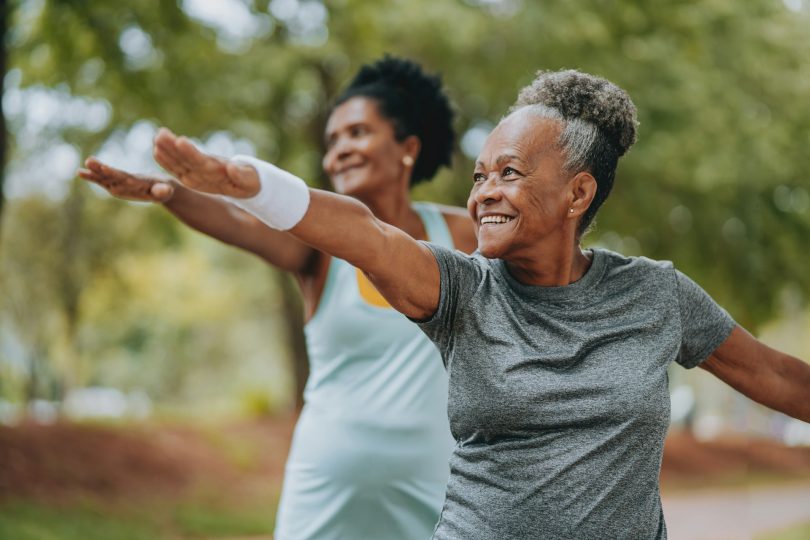
- Stay physically active. Regular exercise (not necessarily intense), such as walking, dancing, and climbing stairs, can help maintain bone density.
- Know the warning signs. Watch for quiet warning signs of bone loss, such as gradual loss of height, stooping posture, or fractures from minor falls.
Most importantly, challenge the myth that Black women don’t get osteoporosis and share accurate information with family and friends to help create awareness.
Late diagnosis of osteoporosis is a real problem with dire consequences. Most doctors under-diagnose and do not even consider testing Black women for osteoporosis because our bone density reduces our risk. Hence, we have to be our own advocates when we go for our yearly exams or physicals. A fracture can lead to long-term pain, reduced mobility, loss of independence, spinal deformities; and, in the case of hip fractures—death.
Thankfully, my Grandma recovered, but her experience taught our family that healthy bones can wear out over time. Black women are not immune to osteoporosis, and recognizing the early signs can make a huge difference. At Elevate Black Health, we urge you to take your bone health seriously, ask questions, and do not let the “stronger bone” myth stand between Black women and the care we need.
To learn more about osteoporosis, visit these sites:
- University Health. Why Osteoporosis Is More Common in Women than Men. https://www.universityhealth.com/blog/osteoporosis-in-women
- NHS Inform. Osteoporosis. https://www.nhsinform.scot/illnesses-and-conditions/muscle-bone-and-joints/conditions-that-can-affect-multiple-parts-of-the-body/osteoporosis/
- Calcified Tissue International. Risk for osteoporosis in black women. https://pubmed.ncbi.nlm.nih.gov/8939764/
- U.S. Preventive Services Task Force (USPSTF). Osteoporosis to Prevent Fractures: Screening. https://www.uspreventiveservicestaskforce.org/uspstf/recommendation/osteoporosis-screening
- Journal of General Internal Medicine. Osteoporosis Risk Assessment and Ethnicity: Validation and Comparison of 2 Clinical Risk Stratification Instruments. https://doi.org/10.1111/j.1525-1497.2006.00459.x
- University of Mississippi. Determinants of Bone Mineral Density in African-American and Caucasian College-Aged Women. https://egrove.olemiss.edu/cgi/viewcontent.cgi?article=2027&context=etd
- Elevate Black Health. Diabetes Made Simple: A Quick Guide. https://www.elevateblackhealth.com/diabetes-made-simple-a-quick-guide/
- Elevate Black Health. Fighting Pain with Technology. https://www.elevateblackhealth.com/fighting-pain-with-technology/
- Elevate Black Health. Active Living for Black Healthy Aging. https://www.elevateblackhealth.com/active-living-for-black-healthy-aging/