

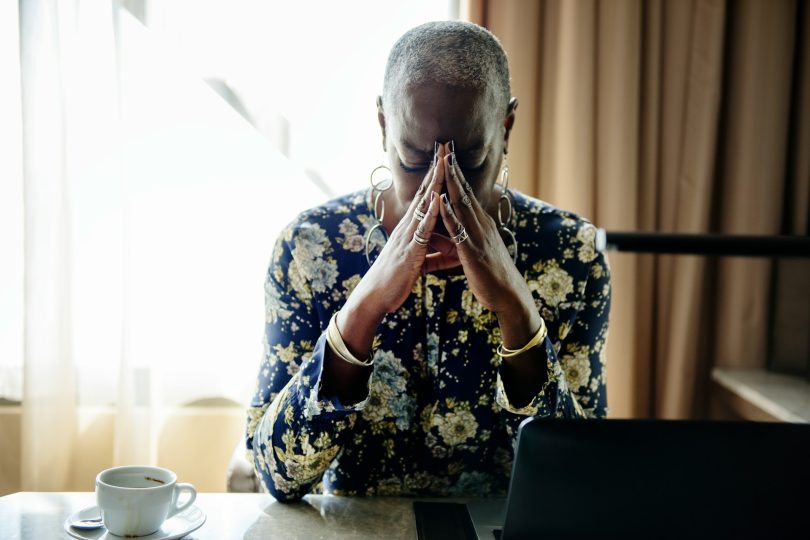

Aging comes with certain vulnerabilities, especially in our community where diabetes, cardiovascular diseases, and stroke often lead to faster physiological decline. Research shows that older Black adults experience higher rates of disability and need help with daily tasks—like dressing, cooking, and bathing—sooner and for longer periods than white adults. The faster physiological decline often leaves older Black adults at the mercy of their loved ones or caregivers.
Dependence makes older Black adults prone to physical and mental abuse, as well as financial exploitation. The first step in tackling domestic abuse among older Black adults is understanding the different ways they can be oppressed because of either their physical immobilization or cognitive impairment.
The Types of Domestic Abuse Black Adults Face
Family members, especially adult children and their spouses, have been identified as the most frequent perpetrators of abuse against older Black adults. Data from the National Center on Elder Abuse (NCEA) shows that across the United States, family members account for nearly 47% of elder abuse incidents, compared to 13% from medical or formal non-family caregivers.
In most cases, when Black elderly adults experience abuse from caregivers, it is usually due to caregiver burnout. Therefore, a caregiver should be required to take breaks and shift roles to others when needed.
The reason is that Black older adults are culturally more likely to choose informal, intergenerational family care networks over nursing homes. The different manifestations of domestic abuse identified by advocacy organizations within the Black community are highlighted below.
1. Psychological Abuse
This is the most pervasive form of abuse faced by older Black adults. Data show that 53.8% of Black women report psychological abuse, including systemic humiliation, name-calling, insults, and coercive control. For older Black men, psychological abuse is mostly in the form of manipulation, invasion of privacy, and threats related to child custody or false legal accusations.
2. Physical Violence
Although less prevalent compared to emotional abuse, more than 4 in 10 Black women experience lifetime physical violence from their partners. Black men also face physical violence at a rate that is about 62% higher than white men. Some of the physical violence scenarios end fatally. The rate of Black femicides by men is 2.5 times the rate recorded among white women.
3. Sexual Abuse
Sexual violence disproportionately affects Black adults. Around 20% of Black women survive rape during their lifetime. The cultural stigma surrounding mental health and sexual violence often makes it harder for victims to report sexual abuse.
4. Financial Exploitation
Financial control can come in the form of controlling the victim’s bank accounts, especially those facing psychological decline, sabotaging employment, and incurring debt in the victim’s name to rob them of financial independence. The lack of intergenerational wealth within our community makes the effect of financial exploitation far-reaching.
5. Spiritual Abuse
In some cases, the abuser weaponizes the victim’s religion or cultural values, like using scripture to justify isolating the victim from their church or faith community. The abuser can also use their high status within a religious community to portray an image of innocence, making it harder for the victim to prove their case.
6. Reproductive Coercion
Abusers can hijack their victim’s reproductive autonomy, including sabotaging their birth control methods, forcing the victim to get an abortion, or pressuring them into pregnancy to make separation more difficult.
Barriers to Help for Abused Black Adults
Although abusers will normally use different tactics to prevent their victims from seeking help, systemic racism and distrust compound the problem for older Black adults dealing with abusive partners, friends, or family members. Some of the factors include:
- Distrust of law enforcement agencies: Black victims are usually hesitant about reporting abuse for fear of institutional racism, police misconduct, or historical weaponization of the legal system against Black men. The victims often fear that law enforcement will use excessive force on their partners or face arrest themselves.
- The masculinity stereotypes: Culturally, Black men are expected to be strong. Reporting an abuse often translates to admitting weakness. Likewise, Black women are often culturally expected to endure adversity in silence. Viewed through this prism, reporting an abusive partner can feel like insubordination.
- Community shielding: In most Black communities, victims are pressured to resolve disputes internally and privately. The excuse is that speaking out will feed into racist stereotypes about violence in Black communities.
How to Detect Abuse in Older Black Adults
The most obvious sign that a Black adult is being abused is to look out for physical scars on their bodies. An unceremonious heavy makeup usage for someone who rarely uses beauty products can be a sign that they are trying to hide something. Likewise, a sudden wardrobe change from revealing or short dresses to clothes that cover the entire body—plus hoodies—is also a popular sign of injury concealment.
Although psychological and financial abuses don’t leave physical scars on the body, they can trigger sudden behavioral changes. If the older adult is being cared for by a caregiver, signs of neglect are usually visible. Otherwise, pay attention to the following:
- Social withdrawal: The Black adult becomes unusually quiet, isolates themselves from church and trusted social circles
- Trauma responses: Out-of-character display of soothing mechanisms like mumbling or rocking back and forth
- Missing property: Sudden disappearance of valuable personal items like jewelry
- Document changes: Unexplained alterations to property titles and Power of Attorney documents
Breaking Free From an Abuser
Leaving an abuser is not often as simple as picking your bag and walking out of the door. In some cases, they will hunt you down. Lethal violence escalation is also common when an abuser realizes they are losing control.
Since older Black adults are usually at a crossroads because of higher caregiver dependence, structural economic inequality, systemic health care disparities, and cultural or religious expectations, safely navigating permanent separation has to be strategically planned as follows:
- Collect important documents like Social Security cards, driver’s license, legal documents (Power of attorney forms and property deeds)
- Abusers often weaponize technology to track and intimidate their victims. Turn off location services
- Build informal networks, including trusted family members, neighbors, or friends who can temporarily shelter or assist during a crisis
- Contact professional institutions like Adult Protective Services (APS) who specialize in providing housing and resources for older adults
Remember, you never have to go through abuse alone. Religious communities usually provide a confidential and safe environment for members of our communities who may be going through any form of crisis.
For More Reading
- Cherry, K. (2022, October 21). Domestic violence varies by ethnicity. Verywell Mind. https://www.verywellmind.com/domestic-violence-varies-by-ethnicity-62648
- Emecheta, A. (2023, July 12). How to detect and prevent abuse from caregivers. Elevate Black Health. https://www.elevateblackhealth.com/how-to-detect-and-prevent-abuse-from-caregivers/
- Emecheta, A. (2023, September 18). Fighting caregiver burnout with technology. Elevate Black Health. https://www.elevateblackhealth.com/fighting-caregiver-burnout-with-technology/
- Favreault, M. M., Dey, J., Marton, W., Lamont, H., & Anderson, L. (2023). Diversity in caregiving needs and networks: Differences by race-ethnicity in the care older adults receive. https://www.ncbi.nlm.nih.gov/books/NBK606657/
- Institute for Women’s Policy Research. (2020, August 10). Violence against Black women: Many types, far-reaching effects. IWPR. https://iwpr.org/articles/violence-against-black-women-many-types-far-reaching-effects/
- Jordan II S. E. (2023, May 15). 15 mental health myths in the Black community. Elevate Black Health. https://www.elevateblackhealth.com/15-mental-health-myths-in-black-community/
- National Council on Aging. (2026, August 28). Get the facts on elder abuse. National Council on Aging. https://www.ncoa.org/article/get-the-facts-on-elder-abuse/
- Our Sisters’ House. (n.d.). Statistics. Our Sisters’ House. https://www.oursistershouse.com/statistics/
- Truman, J. L., & Morgan, R. E. (2014, November). Intimate partner violence. U.S. Department of Justice, Bureau of Justice Statistics. https://bjs.ojp.gov/content/pub/pdf/ipv.pdf
- Waidmann, T., Brown, K., Furtado, K., & Pancini, V. (2025, January 27). State variation in Black and White life expectancy and evolving disparities. Robert Wood Johnson Foundation. https://www.rwjf.org/en/insights/our-research/2025/01/state-variation-in-black-and-white-life-expectancy-and-evolving-disparities.html