
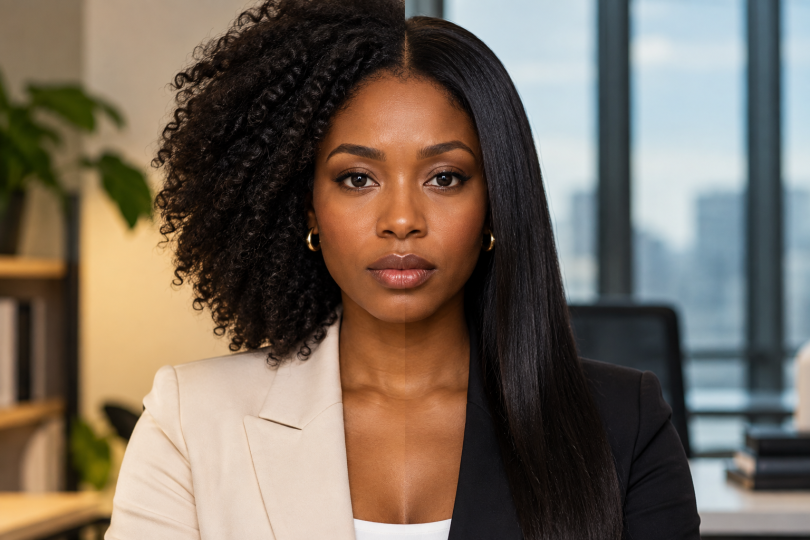

Imagine preparing for a high-stakes job interview, but your main concern is how your hair looks. You have spent years earning your degrees, mastering your craft, and building an impeccable resume. Yet, the night before the interview, you are thinking more about how your hair looks than how you are going to answer the questions. You spend the entire evening applying chemical relaxers or using a flat just to flatten your natural curl and coil. You internally fear that presenting your hair in its natural state will make you look unprofessional and cost you the job opportunity. Unfortunately, this is a reality for many Black professionals and students around the world.
Hair discrimination is often overlooked in corporate, educational, and public spaces. It involves negative bias manifested toward black natural or textured hairstyles typically worn by persons of African descent. In most cases, hair discrimination and texturism may be dismissed as minor office politics or mere cosmetic preference. However, the policing of natural hair is, in reality, a form of socio-cultural abuse that exacts a severe, cumulative psychological toll on victims.
Professionalism and Hair Discrimination
The way professionalism was constructed created the root for hair discrimination experienced to date. In this context, modern workplace aesthetics were established based on the frameworks that elevated European features as the universal standard of neatness and order. For centuries, colonial grooming codes and racial hierarchies institutionalized the idea that straight hair represents discipline while textured hair represented disorder. For instance, the Tignon Laws in the 18th Century legally required Black women to cover their hair with knots and cloths to signify lower social standing.
Years later, hair discrimination remains unchanged to a large extent. Although explicit mandates are now rarer, the underlying power dynamic remains the same. Terms like unprofessional continue to sanitize the proxy for racial bias. In an organization with a dress code that demands tamed, neat, or conservative hair, it is not just about targeting straight hairstyles. Instead, natural Afro-textured styles like locs, braids, afros, twists, and knots are involuntarily labeled as untamed, extreme, or distracting. Consequently, straightening your hair chemically or with heat is framed as demonstrating professional effort.
The impact of hair discrimination is also directly linked to economic equity. Black women wearing natural hairstyles are usually perceived as less professional and less competent in interview settings compared to Black women with straight hair or white women. During recruitment, candidates with natural hair face lower callback rates for corporate interviews. Even after being hired, employees wearing natural styles are more likely to receive subjective negative reviews regarding presentation. In schools, students face suspensions, isolation, or exclusion from milestone events like graduation over natural styles. Cumulatively, in all this, thousands of dollars are spent annually on chemical treatments, salon visits, and heat tools solely to maintain straight hair. This economic penalty creates an intergenerational cycle as parents pass down chemical straightening rituals to their children not out of aesthetic preference, but out of protective fear.
The Psychological Toll: Why Hair Discrimination is Emotional Abuse
Many Black girls and women straighten their natural hair to avoid hair discrimination at school and the workplace. Unfortunately, when your physical appearance is constantly monitored, policed, or penalized by institutions, the psychological impact is more than just feeling awkward. It can lead to stress, anxiety, and self-esteem issues, as individuals may feel pressured to conform to Eurocentric beauty standards. These psychological impacts may include:
- Forced Assimilation and Identity Erasure: Everyone’s hair is deeply tied to their culture, lineage, and personal identity. When you are told that your hair in its natural form is unacceptable, you are being forced to assimilate to survive economically. This forced suppression triggers identity erosion, where you feel that your true self is unwelcome in professional or public spheres.
- Cognitive Load and Hyper-Vigilance: Working in an organization that polices natural hair requires continuous mental effort. Before stepping into that meeting, you will always be hyper-vigilant as you anticipate subtle microaggressions, condescending comments, or boundary-crossing intrusions like a colleague touching their hair without consent. In fact, many Black women report being frustrated at the amount of time and effort it takes to hide salient racialized characteristics about their hair to fit in for job interviews or job situations.
- Internalized Texturism and Self-Worth: Repeated exposure to messages that natural hair is unprofessional eventually internalizes texturism. What begins as external criticism morphs into deep self-doubt and lower self-esteem. Children and young adults who are penalized in schools, banned from sports, denied graduation walks, or sent home for wearing locs and braids, grow up associating their heritage with shame and punishment.
- Physical Harm and Health Risks: The drive to conform is not only mentally exhausting. It carries real physical consequences. Decades of applying chemical straighteners containing endocrine-disrupting compounds, alongside tight pulling from protective styling meant to hide natural texture, lead to scalp damage, severe chemical burns, traction alopecia, and long-term health risks.
Efforts Towards More Inclusive Cultures
Although the progress has been slow, the society is gradually adopting more inclusive cultures. Legislative efforts like the CROWN Act (Creating a Respectful and Open World for Natural Hair) have outlawed hair-based discrimination in schools and workplaces across various jurisdictions. Passing such legislation provides crucial legal protection for natural textures and protective styles. However, legal policy alone cannot dismantle decades of ingrained bias. True progress requires shifting workplace culture from conditional tolerance to complete hair neutrality and radical inclusion.
Hair defines identity, culture, and personal autonomy. Calling someone’s natural hair unprofessional is never a neutral critique of style, but an attack on who they are. Therefore, the professional world needs to make more efforts towards more inclusivity. This may include removing vague terms like neat, tamed, or tactful from employee handbooks and training managers to evaluate employees solely on output and technical proficiency, rather than aesthetic presentation. Other actions may include workplaces fostering psychological safety by establishing clear boundaries against unsolicited comments, intrusive questions, or physical invasion of personal space.
Additional Resources
How Workplace Hair Discrimination Can Impact the Health of Black Women. https://www.consumernotice.org/products/chemical-hair-straighteners/hair-discrimination/
The Crown Act. https://www.thecrownact.com/
The Tignon law: a history of resistance and emancipation. https://maroons.black/the-tignon-law-a-history-of-resistance-and-emancipation/lhistoires-des-noirs/
Black Hair Microaggressions: Understanding Unwanted Comments & Touches. https://www.elevateblackhealth.com/black-hair-microaggressions-understanding-unwanted-comments-touches/
Working with style: Black women, black hair, and professionalism. https://onlinelibrary.wiley.com/doi/10.1111/gwao.12838
The Person Beneath the Hair: Hair Discrimination, Health, and Well-Being. https://pmc.ncbi.nlm.nih.gov/articles/PMC10457631/