

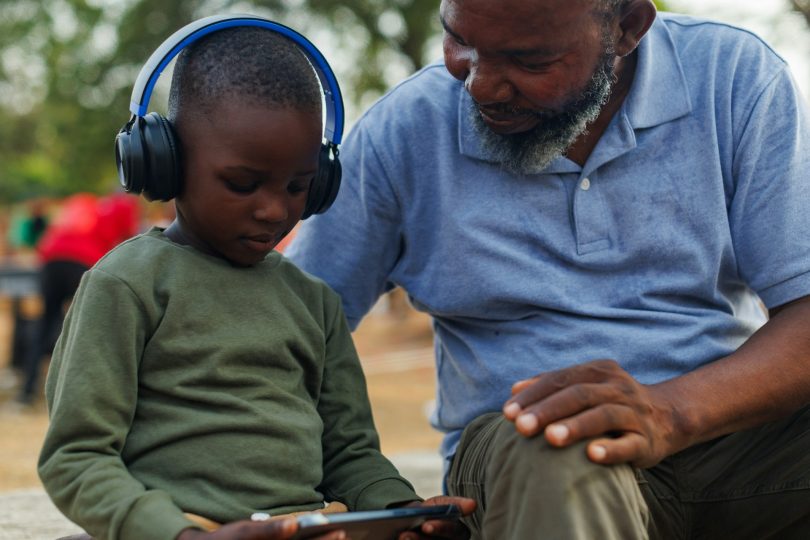

We have a saying in the Black community: “It takes a village to raise a child.” For us, raising children isn’t solely the responsibility of parents—it’s everyone in the extended family.
But because grandparents are often retired, responsibilities that parents, aunties, and uncles should share often fall to grandparents, and they go from simply occasional helping to fulltime raising grandchildren.
In May 2026, North Dakota State University published a finding stating that 6.5 million grandparents lived with at least one grandchild. As if the burden of caring for children is not enough, 2.74 million U.S. children are cared for by their grandparents and depend on them for their everyday needs, according to the U.S. Department of Labor.
While I don’t doubt that parenting from grandpas and grandmas comes from a place of extraordinary love and resilience, you can’t deny that the price they pay takes a toll on them physically, emotionally, financially, and socially.
My question is this: Should we rely on the fact that “it takes a village to raise a child” while our parents suffer because they are raising our children when they are supposed to rest, and we take care of them?
Why Grandparenthood Becomes Parenthood Again
According to the National Library of Medicine, the responsibility of parenting is shifted to the grandparents because of:
- Incarceration
- Financial instability
- Death
- Mental or physical illness
- Parental substance use
These circumstances don’t even leave grandparents with any choice other than the need to protect their grandchildren. Sadly, Black grandparents take the hardest blow in all this when compared to their white counterparts.
First, consider the fact that Blacks are 5 times more likely to be incarcerated than whites in the US, according to the Sentencing Project. Reports from the National Health Statistics also reveal that Blacks have a higher death rate than whites, and when it comes to the wealth gap between Blacks and whites in the US, the gap is miles apart. The Board of Governors of the Federal Reserve System reported that the median wealth of whites is $285,000, compared with $44,890 for Black Americans, which means that whites are more than 5 times financially stable than Blacks.
With these challenges and many others, it becomes easier to understand why Black grandparents—particularly grandmothers—may find themselves raising children for a second time rather than retiring, managing their own health, or simply rest from years of raising their own children. The cycle begins again: school runs, meals, homework, childcare expenses, emotional support, medical care—the list is endless.
The Physical Health Toll
Taking care of a child requires mobility, patience, time, and energy. Even at the prime of age, many parents get exhausted or even break down, yet many grandpas and grandmas go through all these for the second time, sometimes from multiple grandchildren, plus several health conditions like:
- Diabetes
- Heart attack
- Arthritis
- Coronary heart disease
- High blood pressure
- Osteoporosis
- Dementia
- Alzheimer’s
Research findings in ScienceDirect show that Black grandparents who are raising their grandchildren are more likely to develop chronic health conditions, stress, and depression when compared to Black grandparents who are not raising children. Another report from the National Institutes of Health found that many grandparents raising their grandchildren reported poor health due to the high stress of caring for them. They may appear strong but are secretly dealing with anxiety, depression, grief, and exhaustion.
As a young parent, you may already have an idea of what it takes to wake up early to prepare the children for school, spend hours driving them to medical appointments, games, dance or music lessons, while working to make a living. Now imagine doing all that in your 70s and 80s.
I have children, and I can’t wait for them to turn 18 so that I can rest. While I enjoy parenting on some days, it is definitely not what I want to do twice in my lifetime, and absolutely not in my old age. Sacrificing sleep, recreation, medical appointments, exercise, mental peace, freedom, and more is not a fair thing to ask someone to give up twice.
Time will not permit me to begin discussing the toll second-time parenting takes on the financial and social lives of grandparents. It is another whole level of sacrifice.
What Support Should Look Like
The point here is not to label Black grandparenting as bad. On the contrary, for generations, grandparenting has provided children with stability, cultural identity, and a sense of belonging. Many Black children are not separated from relatives and the Black community today when their parents are incarcerated or dead, because of grandparents.
Grandparents have passed down language, values, traditions, family stories, and history that have kept the Black community stronger than it was. The problem today is that our generation is placing the entire burden of care on grandparents without providing adequate support.
We can support by providing:
- Affordable healthcare
- Mental-health services
- Respite care
- Childcare
- Transportation
- Legal assistance
- Financial assistance
- Community-based support groups
Our Black grandparents have always been strong, but strength should not be mistaken for an unlimited capacity to endure. I am not saying grandparents should give less love, but let us not allow them to give up their own health and short future to give that love.
“It takes a village to raise a child” does not mean “it takes a grandparent to raise a child.” Childcare should be a family responsibility, not a burden on grandparents. When the community, healthcare system, and policymakers support grandparents, they are also supporting the child.
Visit These Sites to Learn More:
- North Dakota State University: When Grandparents Become Parents to Their Grandchildren. https://www.ndsu.edu/agriculture/extension/publications/when-grandparents-become-parents-their-grandchildren
- U.S. Department of Labor: Grandchildren Being Raised by Grandparents. https://www.dol.gov/agencies/wb/topics/grandparents-raising-grandkids
- National Library of Medicine: Grandfamilies and the Opioid Epidemic: A Systemic Perspective and Future Priorities. https://pmc.ncbi.nlm.nih.gov/articles/PMC7829093/
- Sentencing Project: The Color of Justice: Racial and Ethnic Disparity in State Prisons. https://www.sentencingproject.org/reports/the-color-of-justice-racial-and-ethnic-disparity-in-state-prisons-the-sentencing-project/
- National Center for Health Statistics: Mortality in the United States, 2024. https://www.cdc.gov/nchs/products/databriefs/db548.htm
- Board of Governors of the Federal Reserve System: Greater Wealth, Greater Uncertainty: Changes in Racial Inequality in the Survey of Consumer Finances, Accessible Data. https://www.federalreserve.gov/econres/notes/feds-notes/greater-wealth-greater-uncertainty-changes-in-racial-inequality-in-the-survey-of-consumer-finances-accessible-20231018.htm#fig1
- Elevate Black Health: Rest, Aging, and Black Health. https://www.elevateblackhealth.com/rest-aging-and-black-health/
- Elevate Black Health: Prepping for Your Own Alzheimer’s Future. https://www.elevateblackhealth.com/prepping-for-your-own-alzheimers-future/
- Science Direct: An intervention to improve the well-being of families in which African American grandmothers are raising grandchildren: A longitudinal mediation analysis. https://www.sciencedirect.com/science/article/abs/pii/S0190740923002165
- National Institutes of Health: African-American Solo Grandparents Raising Grandchildren: A Representative Profile of Their Health Status. https://pubmed.ncbi.nlm.nih.gov/27651164/
- Elevate Black Health: GoFundMe Campaigns and Healthcare Costs. https://www.elevateblackhealth.com/gofundme-campaigns-and-healthcare-costs/